Prepared on Notepad by Ian Smith,
This page created on 27th August 1998, updated 27th January 1999.

Production buses, RM5-7, 9-879, 904-1253, 1255-1452, 1521-2217. (Total 2119)
Re-engineering of standard RMs
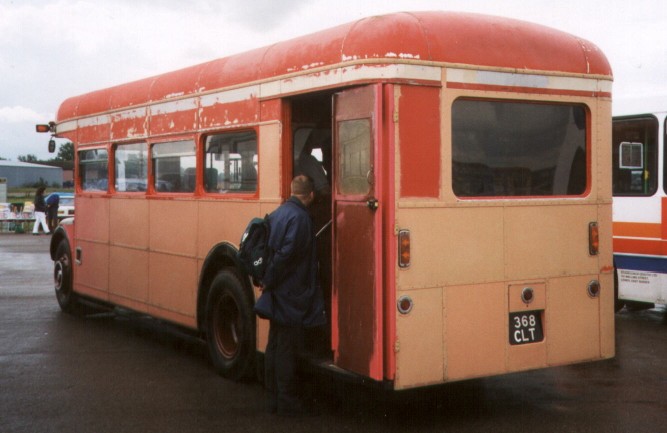
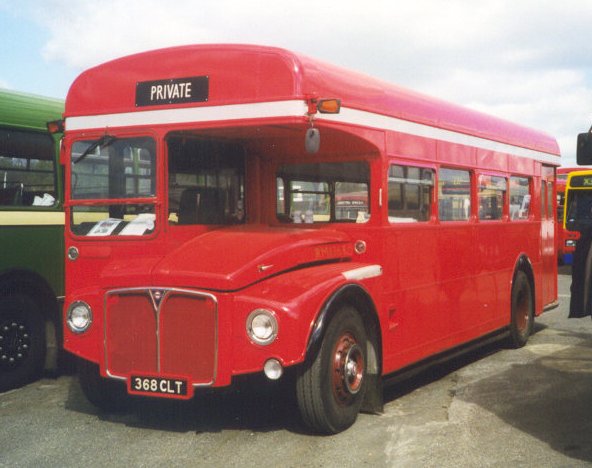
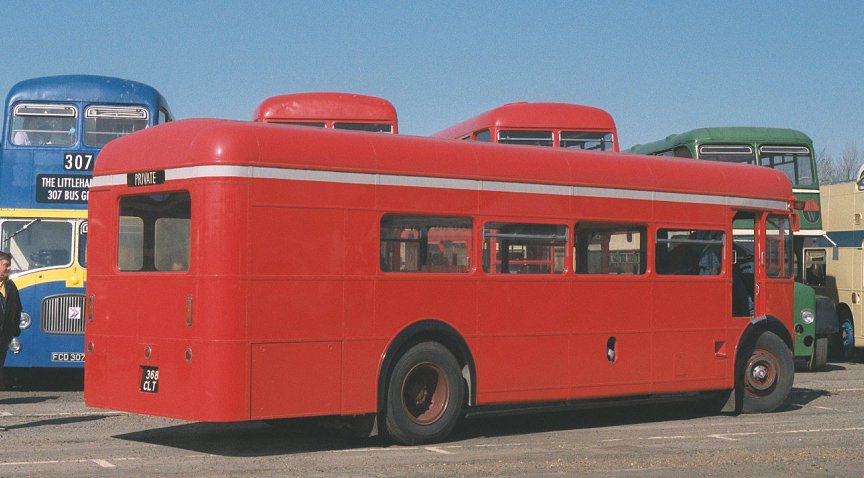
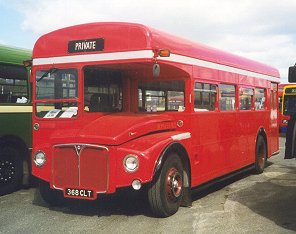
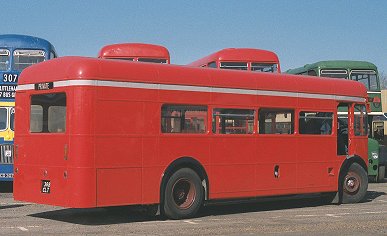
RM 1368: the single-decker RM
RM1368 suffered an arson attack whilst at Tottenham garage on New Years Eve, 1974.
The upper deck was gutted.
After appraisal for reconstruction at Aldenham, it was rebuilt as a single-decker.
As such, it seldom went outside Chiswick works, and never operated public services.
It replaced RM8 as the Chiswick works guinea-pig for RM modification tests.
Happily it is preserved,
and re-appeared on the rally scene at Chatham Dockyard (RMOOA), North Weald (below) and Showbus in 1998.
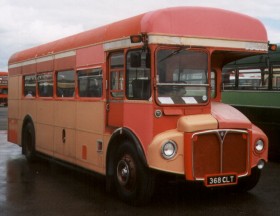
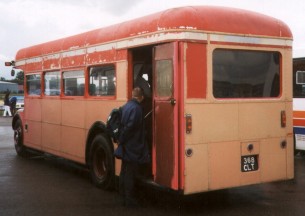
Since then it has been repainted, and appears regularly at RM rallies.
Open-top RMs for London
In 1986 London Transport's input into London sightseeing was given a major renovation.
Private operators had been taking the majority of the business,
but the "new" fleet of 50 Routemasters (RCLs and RMs dedicated to the tour,
plus a good summer,
revived LT's fortunes in this sphere.
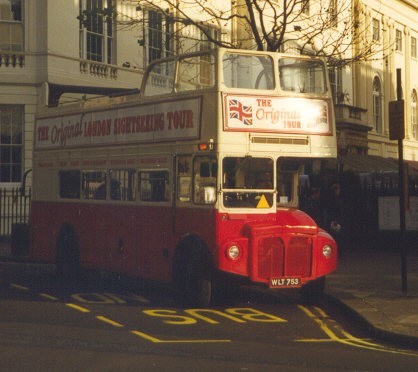
The RMs were given new large posters proclaiming
"The Original London Transport Sightseeing Tour"
(with "Original" on the cross-bar of the LT bullseye),
and had all been repainted at Aldenham into traditional red
with cream cantrail bands and underlined gold fleetnames.
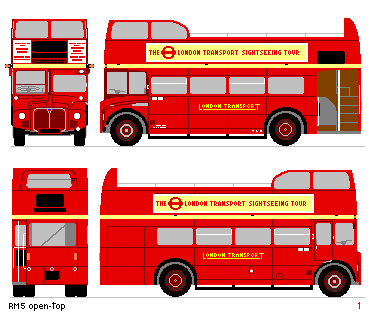 But the major innovation for London was that 20 of the RMs were open-toppers.
Aldenham, in its last major job,
had decapitated them and rebuilt the top decks.
The front windows and the rear dome were kept,
with a wind-hood formed of the front two bays each side.
Waterproof seats and floors were fitted, and extra drain-holes inserted.
The front display panel was altered to RCL style.
On the mechanical side,
they were converted from full-automatic to semi-automatic gears,
to match the RCLs.
The vehicle weight went UP, suggesting that there was hidden work to redistribute the vehicle stresses.
After all you can't just cut the top off an integral body shell without affecting its stiffness!
But the major innovation for London was that 20 of the RMs were open-toppers.
Aldenham, in its last major job,
had decapitated them and rebuilt the top decks.
The front windows and the rear dome were kept,
with a wind-hood formed of the front two bays each side.
Waterproof seats and floors were fitted, and extra drain-holes inserted.
The front display panel was altered to RCL style.
On the mechanical side,
they were converted from full-automatic to semi-automatic gears,
to match the RCLs.
The vehicle weight went UP, suggesting that there was hidden work to redistribute the vehicle stresses.
After all you can't just cut the top off an integral body shell without affecting its stiffness!
The original twenty open-toppers were:
RM 49,   RM 68,   RM 80,   RM 84,   RM 90,   RM 94,   RM 143,
RM 235,  RM 242,  RM 281,  RM 313,  RM 398,  RM 428,  RM 438,
RM 562,  RM 658,  RM 704,  RM 752,  RM 762,  RM 925.
The twenty open-toppers were a great success with the public,
and it soon became apparent that some of the other thirty RMs should be converted too.
RM 163 and RM1919 were converted to open-top in May 1986.
A batch of RMA conversions followed,
then early in 1987 LT acquired two more open-toppers,
that had been converted by LT then sold for use at the Liverpool Garden Festival.
LT re-possessed the two buses in December 1996 from the operators.
RM1783 and RM1864 had been converted like the others,
except for retaining the standard 3-piece display at the front.
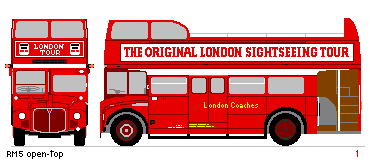 A further seven of the unit's closed top RMs were converted in early 1988,
ready for the summer,
and included two fitted with wheelchair access through a pair of nearside
doors and a wheelchair lift.
The removal of seats from the front two bays, leaving four normal seats plus the six above the wheelarches,
left space for four wheel-chairs.
A further seven of the unit's closed top RMs were converted in early 1988,
ready for the summer,
and included two fitted with wheelchair access through a pair of nearside
doors and a wheelchair lift.
The removal of seats from the front two bays, leaving four normal seats plus the six above the wheelarches,
left space for four wheel-chairs.
RM 307,  RM 450   were converted by Carlton PSV, (with wheelchair lift)
RM 237,  was converted by Carlyle,
RM 377,  RM 572,  RM 644,  RM 753  were converted by Kent Engineering.
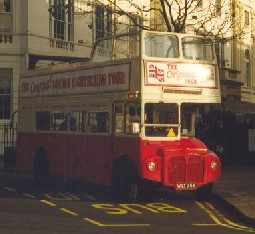
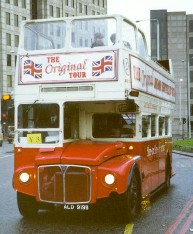
December 1998. These days the open-toppers keep going all year round,
come sun, rain or snow. RM753 (left) waits in midday sunshine for customers
at the lay-by just north of Trafalgar Square.
Later the same day, after sporadic showers driven by a cold biting wind,
RM1919 draws away from Tower Hill with some hardy souls on the top deck.
Photos by Ian Smith. Click for larger versions.
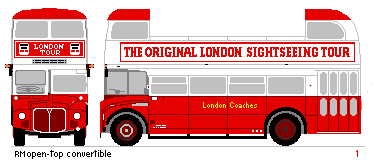 In 1990 two of the remaining standard RMs in the sightseeing fleet
(RM 313 and RM 398)
were rebuilt with RMC style rear ends and closing doors,
enabling them to be fitted with tape facilities.
In 1990 two of the remaining standard RMs in the sightseeing fleet
(RM 313 and RM 398)
were rebuilt with RMC style rear ends and closing doors,
enabling them to be fitted with tape facilities.
Two more (RM 479 and RM 710) received the RMC platforms and doors in 1991,
and together with RM 313 and RM 398 were rebuilt to convertible open-top.
Also in 1991 a new livery of red and white was adopted.
London Coaches, the operating unit for the sightseeing fleet,
became a separate subsidiary company under London Buses,
and was then sold to its management in May 1992.
The buses were relabelled as "The Original London Sightseeing Tour",
with the labels mounted in frames, on the sides
and also covering the destination blinds.
(This gives a weird effect at night, as the original panels shine through the adverts!)
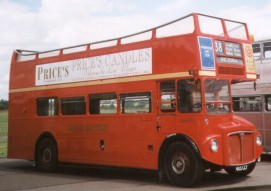
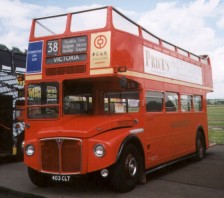
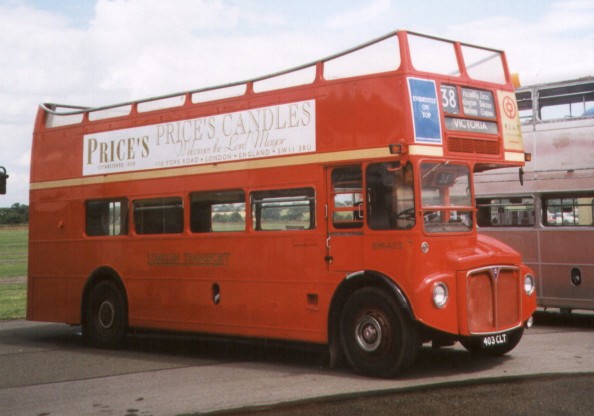
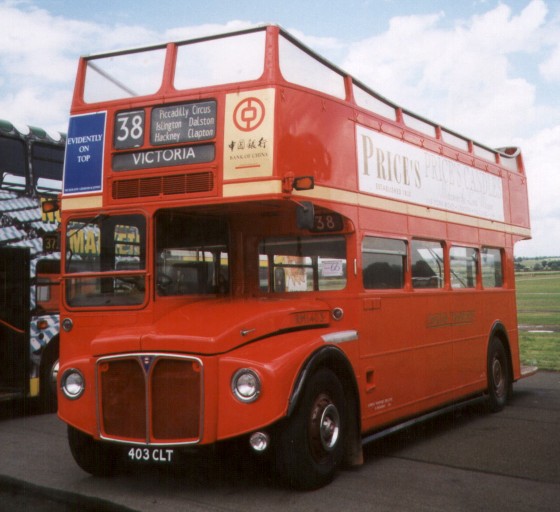
RM 1403 shows a different style of open-top conversion,
carried out by London Transport for Ind Coope.
For many years this open-topper promoted Benskins Breweries
and it is now in preservation (North Weald 1998)
Stretched RMs: the ERMs
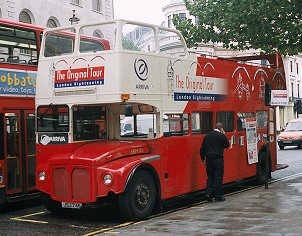
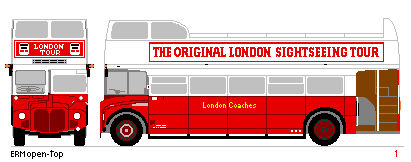 London Coaches made the most of the RM modular construction in 1990,
when ten of the standard RMs had an extra full-length bay inserted,
making them the longest RMs (yet!)
London Coaches made the most of the RM modular construction in 1990,
when ten of the standard RMs had an extra full-length bay inserted,
making them the longest RMs (yet!)
The ten were reclassified as ERMs:
ERM 80, ERM 84, ERM90, ERM94, ERM143, ERM163, ERM235, ERM237, ERM242, ERM281.
Subsequently some of the ERMs were reregistered,
and the fleet numbers adjusted to coincide with the last two digits of the new registration numbers.
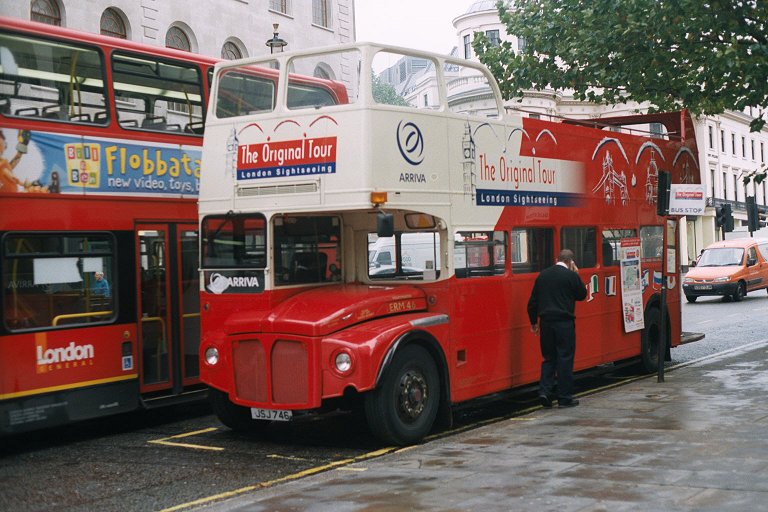
After the takeover by Arriva the fleet livery was altered too,
becoming a variation on the Arriva ice-cream scoop livery.
(ERM46, seen at Charing Cross on 26th October 2001 shows both reregistration and the later livery).
All the ERMs were sold by TOLST in early 2002,
and were snapped up by Mac Tours for Edinburgh Sightseeing duties.
Even one that had been bought for private preservation was soon added to the Mac Tours fleet
(along with other RM types: RM, RCL, RMA).
Hospitality Buses
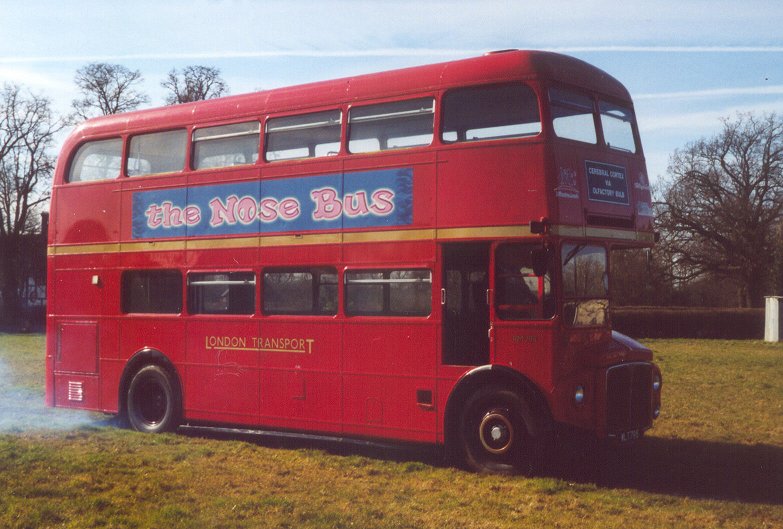
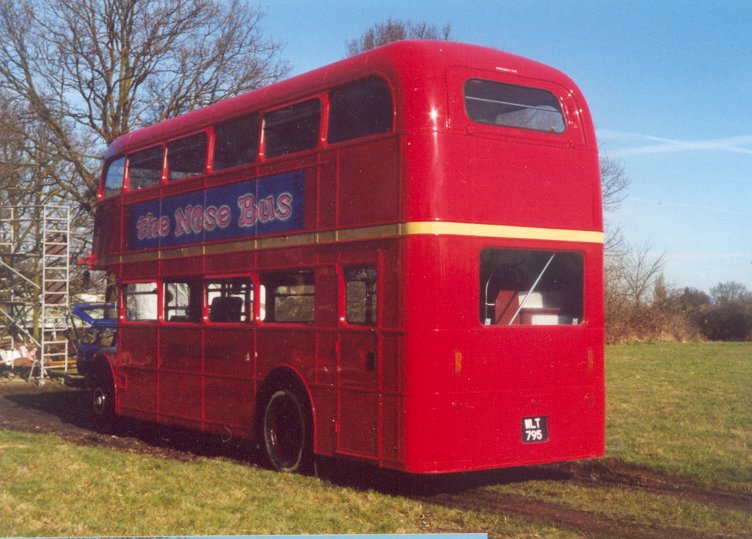
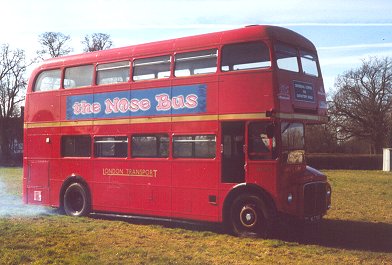
London Transport converted RM795 to a hospitality bus in 1987 for Marley Extrusions.
This involved fitting a generator under the stairs (plus shore supply point),
removing all downstairs seating and fitting display / beverage perimeter shelves,
installing a bar area upstairs and replacing the upstairs seating with table and chairs sets
(some singles from Swifts!) (H16/0), and removing all blind windows. A proper platform door was fitted.
It later became a chemistry demonstrator in Kent, acquiring a London Transport livery style
and prominent Nose Bus adverts.
In 2001 it was bought for preservation by Mike Dawes,
and appeared at East Grinstead Running Day in 2002,
where its hospitality area was much appreciated by crews.

 Nationalisation and Privatisation
 Re-engineered RMs
 RMs Resurrected: Marshall Rebuilds
 Bus Stop
 RM Contents
production RMs
Photo references.
Bus Histories..
RM Contents
production RMs
Photo references.
Bus Histories..
|