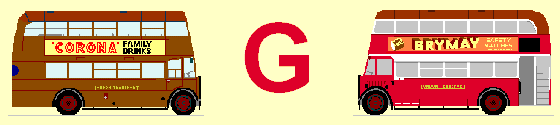
The LONDON TRANSPORT G classThis page created 15th March 1999, by Ian Smith
The Utility Guys: IntroductionThe G-class was not London Transport's first experience of utility buses, or even of Guys. There had been a number of heavy duty six-wheelers trundling around London in the fleets of the independents early in the thirties - the Guy Six class - but Guy had dropped out of the home bus market before the war. It was something of a surprise for the UK bus operators to discover, half way through the war, that Guy was to be THE bus chassis supplier. The usual chassis suppliers were all busy on military equipment: aircraft, tanks, military trucks... and once the supply of part-completed chassis had been "unfrozen" there were no more from AEC, Leyland or Bristol. These unfrozen chassis had been distributed in 1941-2, and had formed the basis of a batch of STLs, a batch of utility-bodied STDs and a batch of utility bodied Bristol Bs for London.
The first batch of Guys had short bonnets and Park Royal bodywork. They required fitting with robust sidelight holders and side route displays before painting and entry into service. Only the first few had red paintwork from the beginning.After that things became steadily more complicated. Mid-1943 saw the arrival of a further 65 Park Royal Arab IIs, very similar to the first lot but with a projecting radiator signifying that these were Arab Mk IIs. The extra five inches was to accommodate the much-sought-after Gardner 6LW - which none of the London Guys had. The extra inches also pushed the buses beyond the legal length limit, so dispensation had to be sought for the buses to carry an empty five inches of bonnet around. In 1944 London was allocated only two Guys, with experimental Weymann metal bodywork. By 1945 London was fairly desperate for buses, having received only 123 buses against their request for 360 in 1943, and a total of only 33 in 1944. On the other hand, the supply situation was easing, with Daimler supplying chassis, Bristol about to restart and a hope that Leyland and AEC would not be long. The Ministry suddenly had a glut of unwanted Guys coming off the production lines, and shuffled as many as the could to London Transport. They had been shouting for buses. Well here they were! They were an eclectic mixture, with bodies by Park Royal, Northern Counties, Massey and Weymann, with some of the Park Royal allocation actually subcontracted to Northern Coachbuilders. Just to add to the fun, one of the Park Royal buses was also a unique metal-framed version, while there was also a Northern Coachbuilders rebuild of a destroyed body. From its pre-war vision of a standardised fleet of smooth, modern attractive vehicles, built to the highest standards, London Transport found itself with a mongrel fleet of utilitarian vehicles built from substandard materials: 435 Guys, 281 Daimlers, 29 Bristols and 11 Leylands. But they had not forgotten their aim, and the Guys and Daimlers were regarded as a stop-gap, to keep the public travelling until the RTs could arrive. The RT family eventually displaced them at the start of the fifties, by which time LT was having difficulty holding some of the utility bodies together, as the unseasoned wood rotted and the steel screws rusted and split the framing. Many then went for service elsewhere, mostly carrying new bodies on the reliable chassis. One codicil to the story was the post-war Arab III with modern Park Royal bodywork. Built speculatively by Guy, it became London Transport's G436 and lived a solitary existence until sold off with the post-war Leyland STDs. Another group of Guy Arabs joined London Transport in September 1951. These ten came with the Eastern National operations in Grays, taken over by LT. They stayed until December, in Eastern National livery, but with London Transport fleetnames. Contents
|
 The latter two types had utility bodywork by
  Bus Stop
 Guys Intro.
 Guy Arab I