
The London Country RB,RS Reliance CoachesThis page created 28th November 2002 by Ian Smith
1977: RS 1-15, RB 16-30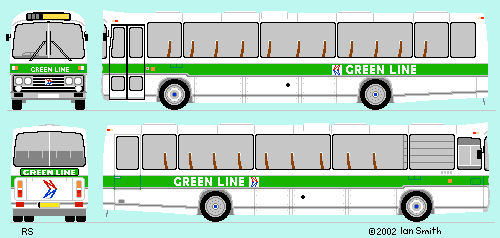 The RS and RB Greenline coaches were an overdue attempt to stop the rot in Greenline patronage.
Earlier attempts at modernisation with Reliance coaches had been less than successful
due to the unreliability of earlier generations of Reliances, the RC and RP classes.
The Leyland National LNC and SNC classes had brought reliability,
but with it came plastic seats, lots of engine noise and a lack of the first-class amenities
that Greenline customers paid a premium for.
The RS and RB Greenline coaches were an overdue attempt to stop the rot in Greenline patronage.
Earlier attempts at modernisation with Reliance coaches had been less than successful
due to the unreliability of earlier generations of Reliances, the RC and RP classes.
The Leyland National LNC and SNC classes had brought reliability,
but with it came plastic seats, lots of engine noise and a lack of the first-class amenities
that Greenline customers paid a premium for.
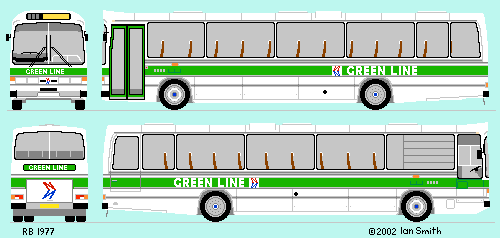 Now, in 1977, the quality was to make a comeback, with the first tranche of Greenline vehicles
that had recognisable coach bodies. London Country chose the AEC Reliance 760 chassis,
with a massive 11.6 litre engine
with bodywork either the Duple Dominant (from Blackpool: the RB class),
or the Plaxton Supreme from Scarborough: the RS class).
The two classes were numbered into a common sequence.
The coaches were acquired new, on lease from Kirby Central,
with the intention of taking thirty new coaches a year for five years,
on five year leases.
Now, in 1977, the quality was to make a comeback, with the first tranche of Greenline vehicles
that had recognisable coach bodies. London Country chose the AEC Reliance 760 chassis,
with a massive 11.6 litre engine
with bodywork either the Duple Dominant (from Blackpool: the RB class),
or the Plaxton Supreme from Scarborough: the RS class).
The two classes were numbered into a common sequence.
The coaches were acquired new, on lease from Kirby Central,
with the intention of taking thirty new coaches a year for five years,
on five year leases.
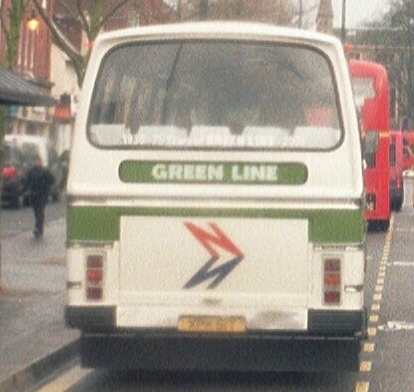
They had forced-air ventilation - although the drivers found their space somewhat warm in hot weather, large panorama windows, and large luggage racks behind the driver (London Country installed these on receipt). I gather that they were a nice vehicle to ride in. Although the two types of body were superficially similar, they differed from each other almost totally: in window size and spacing, windscreens and rear windows, emergency exits, lamp layouts, driver position... Into serviceAt the end of January 1977 the first signs of the new broom were seen: the old 712 and 713 routes were withdrawn, and the 714 between London and Luton was replaced by new services 707 and 717, connecting Victoria and Luton Airport with faster journey times. The 717 also served Borehamwood and Hendon, plus the new shopping megacentre at Brent Cross. St.Albans garage serviced the new routes with new RS coaches. In April RS coaches also made their debut on the 727 connecting Luton and Gatwick Airports, working from Reigate and St.Albans.The RBs made their debut from Windsor in May on new service 700, which served the Windsor tourist traffic during the Queen's Silver Jubilee Year with a summer-only non-stop M4 motorway dash from/to London. Once enough were delivered they began to make appearances on the 704/705, which from May began to serve Heathrow Airport! Guildford services also received RBs for the recast 715, which now served Kingston. Amersham received a pair for the 790 (London- High Wycombe - Amersham), which was jointly timetabled over this section with Oxford South Midlands' route 290. Northfleet received the remainder of the first batch of RBs. 1978: RS31-45, RB 46-60 The 1978 batch comprised another thirty, split equally between Duple and Plaxton again,
to more or less the same designs as the first batches. The RBs had minor differences at the rear,
relating to the rear light clusters.
The 1978 batch comprised another thirty, split equally between Duple and Plaxton again,
to more or less the same designs as the first batches. The RBs had minor differences at the rear,
relating to the rear light clusters.
Into serviceNow it was RS types that went to Windsor in the spring, as well as to Reigate for the 727. The Windsor coaches helped launch the 701 service (London - Hammersmith, then M4 to Heathrow, then on to Windsor and the Safari Park) in May. The 705 operated only on Sundays (Windsor - London - Westerham - Tunbridge Wells).
Preserved RB51 at Quainton Road. Photo, used with permission, by William Tarbit. Right: RB51 at St.Albans, Jan2006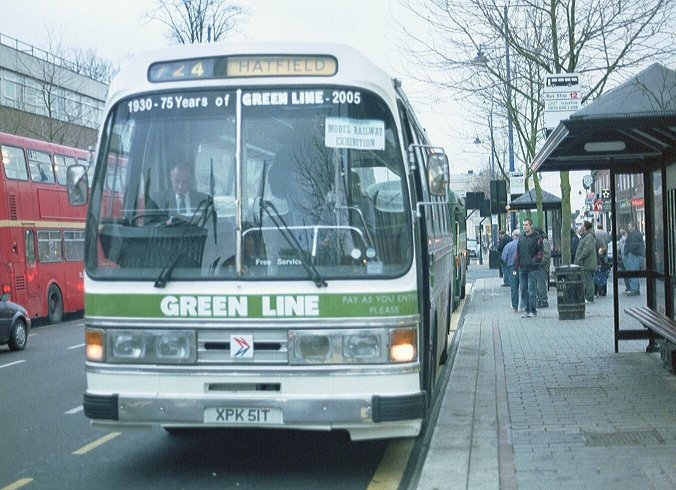

RB51 on 724 at St.Albans Running Day, January 2006, and at Hatfield StationFrom late summer throught the autumn RS deliveries went to Stevenage and Hatfield.
Meanwhile RBs arrived for Staines and Harlow revitalising the 718 and the orbital 725/6 and 724 routes,
as well as top-ups for Windsor and Reigate.
1979: RB 61-105, RS106-120, RB121-135, RS136-150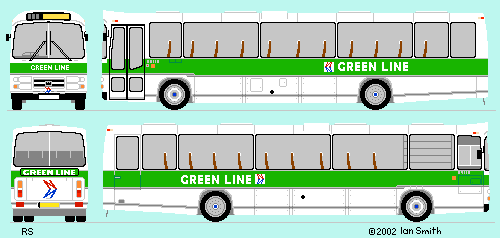 With the success of the new Greenline coaches apparent in the rider numbers and vehicle reliability,
the leased coaches programme was accelerated, introducing ninety of the coaches in 1979
instead of the original planned thirty. Thirty were bodied by Plaxton, to an updated style,
with a new front treatment with new headlamp clusters placed vertically, and a different doorway style too.
Sixty were Duple bodied, to the 1978 pattern.
With the success of the new Greenline coaches apparent in the rider numbers and vehicle reliability,
the leased coaches programme was accelerated, introducing ninety of the coaches in 1979
instead of the original planned thirty. Thirty were bodied by Plaxton, to an updated style,
with a new front treatment with new headlamp clusters placed vertically, and a different doorway style too.
Sixty were Duple bodied, to the 1978 pattern.
Into service Anticipating the April 1979 division of the 704 into two parts, with the London to Tunbridge Wells section becoming the 706,
Dunton Green received some of the early 1979 deliveries of RBs.
Others went to Dartford, Northfleet and Windsor and Staines.
Anticipating the April 1979 division of the 704 into two parts, with the London to Tunbridge Wells section becoming the 706,
Dunton Green received some of the early 1979 deliveries of RBs.
Others went to Dartford, Northfleet and Windsor and Staines.
In April Staines also received RBs with yellow banding and branding for the new Jetlink 747 non-stop service between Heathrow and Gatwick. It competed with the new helicopter link, and provided an hourly service from 0530 onwards. It became popular enough for the frequency to double, with night-time services added, within two years.
Hertford routes were also revamped: route 735 worked via Wood Green to Oxford Circus,
while new orbital 734 worked from Hertford to Wood Green, then through Brent Cross,
Hounslow and Heathrow to Addlestone.
New coaches were allocated accordingly,
but despite massive publicity the 734 failed to attract sufficient custom.
In 1982 the five year leases began to run out. London Country was aware that maintaining a modern image was important for its GreenLine clientele. (Complaints when older buses were substituted for RBs or RSs were very vociferous!). So the Reliances started to go off-lease, replaced by Leopards and then Tigers. The buses had to be returned to the lessors in as-received condition, as near as practicable, so they went for refurbishment before return, many at Midland Red or United Counties at Milton Keynes. By the end of 1985, the original target date for lease expiry, they had all gone, all except the few casualties on to pastures new throughout Britain. They had served London Country well, and helped bring Greenline back from the edge of extinction.
|

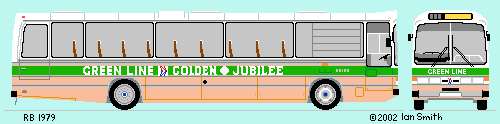 1980 brought its own celebrations, opportunities and challenges.
London Country celebrated fifty years of Greenline by giving some of the coaches a Gold lower bodyside, with Golden Jubilee lettering.
1980 brought its own celebrations, opportunities and challenges.
London Country celebrated fifty years of Greenline by giving some of the coaches a Gold lower bodyside, with Golden Jubilee lettering.
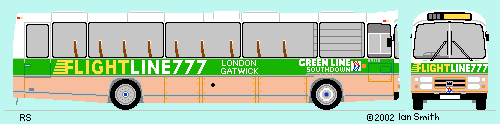 This type of co-operative extension was to see Green Line extending to Cambridge in association with Eastern Counties (797,798);
to Guildford estates, Farnham and Cranleigh (740, 741, 742) jointly with Alder Valley;
to Reading (Alder Valley, 733); and to Gatwick and Crawley (Southdown, 777).
This last service took the buses adorned with the gold Jubilee bands and rebranded them as Flightline 777,
with both Southdown and London Country fleetnames.
This type of co-operative extension was to see Green Line extending to Cambridge in association with Eastern Counties (797,798);
to Guildford estates, Farnham and Cranleigh (740, 741, 742) jointly with Alder Valley;
to Reading (Alder Valley, 733); and to Gatwick and Crawley (Southdown, 777).
This last service took the buses adorned with the gold Jubilee bands and rebranded them as Flightline 777,
with both Southdown and London Country fleetnames.
 Ian's Bus Stop
 Index
Index RN
RN RS,RB text
 histories