
The LONDON COUNTRY Swift Coaches, SMA 1-21This page created 20th May 2001 by Ian Smith.
The new London Country, in the early 1970's, found itself with an aged if reliable rolling stock plus a sprinkling of new AEC Merlins, Swifts and Reliances that were far from reliable. It was desperate for new buses, especially for the Green Line services where it could not economically justify its crew-operated Routemasters.
The new coaches were Swifts with paltry 8.3litre engines mounted at the rear, with very un-London Alexander W bodies. These featured long and deep picture windows of two heights, that coupled with a floor that ramped up from beside the driver to above the rear axle gave a superb view to passengers: the seats ramped up as well, as in a theatre. The ramping floor also gave relatively easy access at the front. Dual purpose seats with head-rests were fitted. The front bore an aggressive mock grille, with heavy barring and twin headlamps, that actually only incorporated a tiny air intake for cab ventilation. At the rear there was a dome with Alexander-style inset window, with a route indicator box squeezed in above the engine compartment.
They were nicely finished in darkish green with a lime band,
like the RC Reliances and the modernised RFs.
Green Line fleetnames were in yellow,
and they sported the flying polo London Country logo.
Into serviceThe whole batch went into service on the south-orbital 725 route, operating from Northfleet and Windsor garages (with the occasional foray onto the 704). They immediately proved under-powered. The 725 route includes some fearsome hills each side of Bromley, at Chislehurst and Shortlands, and with an un-blown 8.3 litre engine they struggled (even more than the Swifts on the 227, tackling the same hills).
They stayed on the 725, and its Heathrow-visiting addendum, the 726. One or two at a time, surplus to the route requirement, worked at Crawley. The 726 survived the ravages that struck most of the Green Line network probably because it provided a service that the railways didn't. But the SMAs were worn out after six years or so on the route, and went for scrap.
|
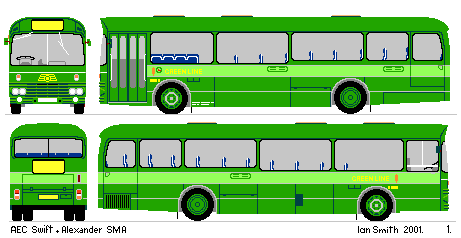 The opportunity arose to receive a batch of twenty-one Swifts with Alexander dual-purpose bodies.
They had been ordered by South Wales Transport, but were diverted to London Country,
arriving in early 1972.
The opportunity arose to receive a batch of twenty-one Swifts with Alexander dual-purpose bodies.
They had been ordered by South Wales Transport, but were diverted to London Country,
arriving in early 1972.
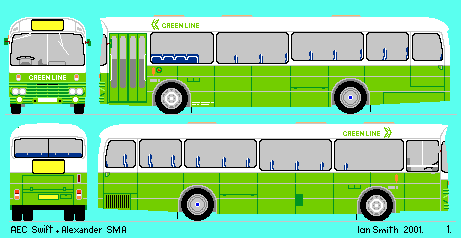 Before long the diktats of the central praesidium of the National Bus Company decreed that
NBC buses should look the same throughout the land,
irrespective of earlier liveries, save that poppy red or leaf green could be chosen,
coupled with white for dual-purpose vehicles. And thus the SMAs lost their GreenLine livery,
and adopted NBC green with white tops. Green Line status was recognised only in the fleet names.
Before long the diktats of the central praesidium of the National Bus Company decreed that
NBC buses should look the same throughout the land,
irrespective of earlier liveries, save that poppy red or leaf green could be chosen,
coupled with white for dual-purpose vehicles. And thus the SMAs lost their GreenLine livery,
and adopted NBC green with white tops. Green Line status was recognised only in the fleet names.
 Bus Stop
 index.
 SMW
SMW SMA text.
 histories