The Stagecoach London Volvo Olympians
This page created 24th November 2006 by Ian Smith
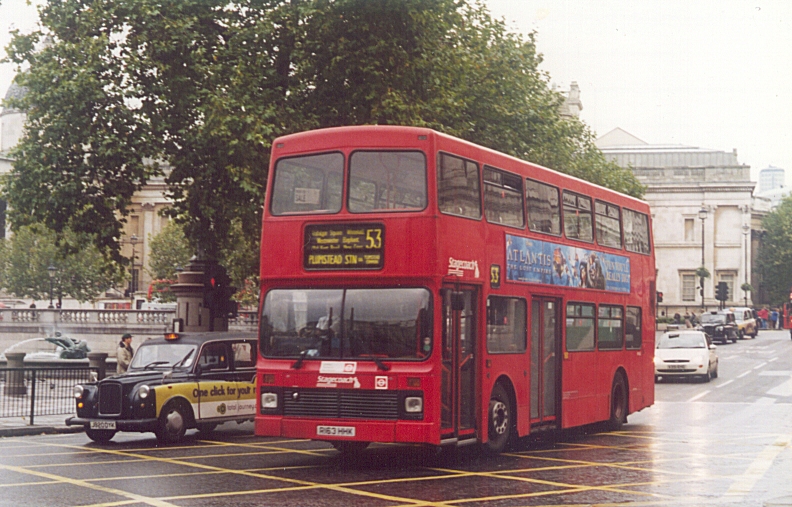
301-352: the Plumstead standards Stagecoach took on East London and Selkent in autumn 1994, with a large fleet of Titans,
some Leyland Olympians, some Scanias and a large helping of Routemasters. The last were route-tied,
but the Titans, without benefit of Aldenham overhauls , were up to fifteen years old and getting tired.
The first priority was to replace the Titans on the 53 group (53, 53X and N53), at Plumstead,
which required fifty-two new buses. Dual doorway buses were required for this busy trunk route
(Plumstead Station - Trafalgar Square).
Stagecoach chose standard Volvo Olympians with Cummins engines and Northern Counties bodywork,
with straight staircases.
Selkent demonstrated their ability to respect tradition yet do their own thing by painting them plain overall red but
just numbering them 301-352, without a type code.
Stagecoach took on East London and Selkent in autumn 1994, with a large fleet of Titans,
some Leyland Olympians, some Scanias and a large helping of Routemasters. The last were route-tied,
but the Titans, without benefit of Aldenham overhauls , were up to fifteen years old and getting tired.
The first priority was to replace the Titans on the 53 group (53, 53X and N53), at Plumstead,
which required fifty-two new buses. Dual doorway buses were required for this busy trunk route
(Plumstead Station - Trafalgar Square).
Stagecoach chose standard Volvo Olympians with Cummins engines and Northern Counties bodywork,
with straight staircases.
Selkent demonstrated their ability to respect tradition yet do their own thing by painting them plain overall red but
just numbering them 301-352, without a type code.
They arrived between June and October 1995, and were filtered into service as they came. There were enough for them to take on other Plumstead routes as well.
June 2001 on the 47: Catford is putting to use 302 (seen at Deptford), and VN316 (seen at Lewisham).VN1-VN26: stretched for Romford, and Upton Park The next batch, in 1996, were different. Stagecoach was well aware that the new step-entrances were vulnerable
once the impending low-floor revolution extended to double-deckers, and argued that an ability
to transfer the buses readily to other fleets - many of which required less than full height buses -
would make their tenders cheaper, whilst not seriously impeding Londoners by a dearth of headroom.
Likewise, longer, larger capacity buses with single doorways were surely acceptable in the suburbs?
So this small batch were to Stagecoach national specification, slightly lower, slightly longer (10.3m instead of 9.6m),
and single doorway.
The next batch, in 1996, were different. Stagecoach was well aware that the new step-entrances were vulnerable
once the impending low-floor revolution extended to double-deckers, and argued that an ability
to transfer the buses readily to other fleets - many of which required less than full height buses -
would make their tenders cheaper, whilst not seriously impeding Londoners by a dearth of headroom.
Likewise, longer, larger capacity buses with single doorways were surely acceptable in the suburbs?
So this small batch were to Stagecoach national specification, slightly lower, slightly longer (10.3m instead of 9.6m),
and single doorway.
VN1-26 went to North Street in Romford for the 374 (Harold Hill - Romford Station), starting in September 1996, and to Upton Park for the 262 (Stratford - East Beckton) and 473 (Stratford - North Woolwich), starting in October.
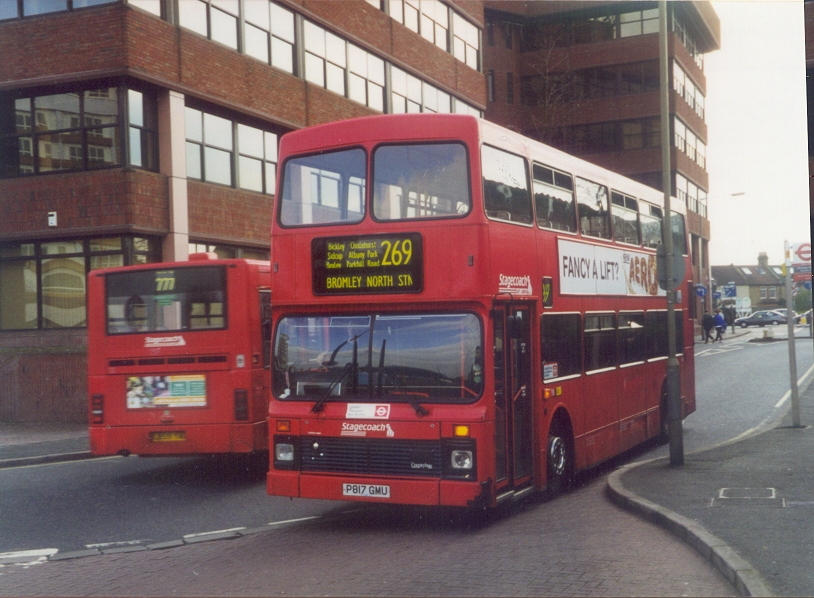
Front doorway stretched Olympian VN17 on the 269 at Bromley North in March 2000.VN1-3 gained repaints into the new liveries, with rear up-swoops of colour, deep blue skirts, and different base colours. They became 16001-3 in the January 2003 renumbering. September 2005 saw them finally make a move, but only as far as Waterden Road garage on Hackney Marshes.
Showbus at Duxford, September 2005: East London Coaches 16001 in white, ex-pat 16007 in National livery for United Counties.VN27-VN43: long low two-doors for Bow Route 26 (Waterloo Station - Hackney Wick), went into London,
so two doors were demanded to produce briefer stops. Bow received seventeen of the
slightly low, slightly longer buses, but dual-doorway, in November and December 1996.
Route 26 (Waterloo Station - Hackney Wick), went into London,
so two doors were demanded to produce briefer stops. Bow received seventeen of the
slightly low, slightly longer buses, but dual-doorway, in November and December 1996.
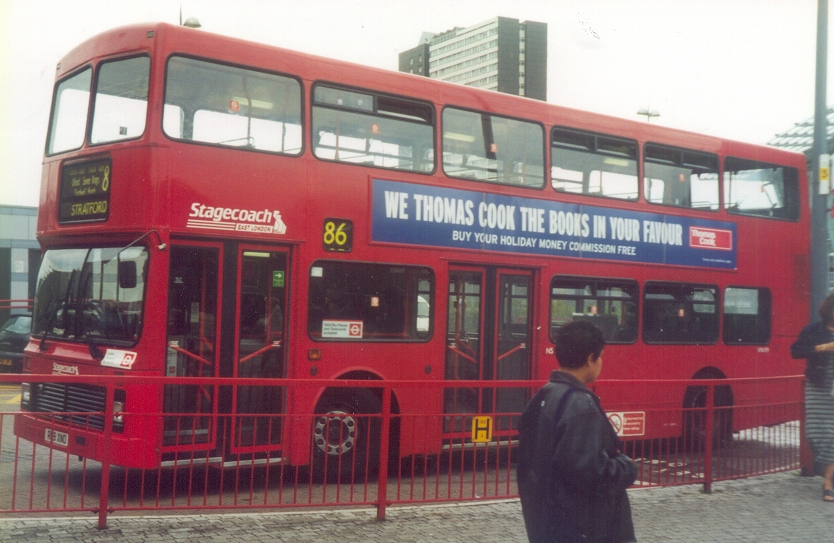
Eight of them (VN27-34) moved on to North Street to partly convert the 86 (Stratford - Romford Stn) in the following August, when Alexander bodied VAs arrived at Bow in strength. VN35-43 moved to Plumstead in the spring of 1999, but later moved on to North Street, where the whole batch had congregated by the end of 2000. VN27-34 moved off to Leamington in 2001, VN35-40 to Fife in August 2002, and VN41-43 to Manchester in July 2003. The whole batch was returned off-lease to Volvo at the end of 2003. Three were then bought by Finglands in Manchester, eleven by First Manchester and the last three by First Hampshire & Dorset.
VA44-VA81: long low two-door Alexanders for Bow The long wheelbase, slightly low, body offered by Alexander offered a slightly larger seating capacity
(79 rather than 74), and again was to be a Stagecoach national standard.
Thirty-eight of them arrived at Bow in the summer of 1997. Eight of their VNs promptly moved to North Street,
but Bow used the increased allocation to partly convert other routes from Titans:
the 25 (Oxford Circus - Ilford), 277 (Highbury & Islington Stn - Leamouth),
and D7(Mile End - Poplar).
The long wheelbase, slightly low, body offered by Alexander offered a slightly larger seating capacity
(79 rather than 74), and again was to be a Stagecoach national standard.
Thirty-eight of them arrived at Bow in the summer of 1997. Eight of their VNs promptly moved to North Street,
but Bow used the increased allocation to partly convert other routes from Titans:
the 25 (Oxford Circus - Ilford), 277 (Highbury & Islington Stn - Leamouth),
and D7(Mile End - Poplar).
But their tenure of these routes was brief. In 1999 the 25 and D7 were taken over by First. The 277 acquired low-floor Tridents. Many of the VAs moved on to other Bow routes: the 473 (Stratford - North Woolwich), 262 (Stratford - East Beckton), displacing the single door VNs that had been at Upton Park for these routes. Bow also used their VAs on the 241 (Stratford - Canning Town).
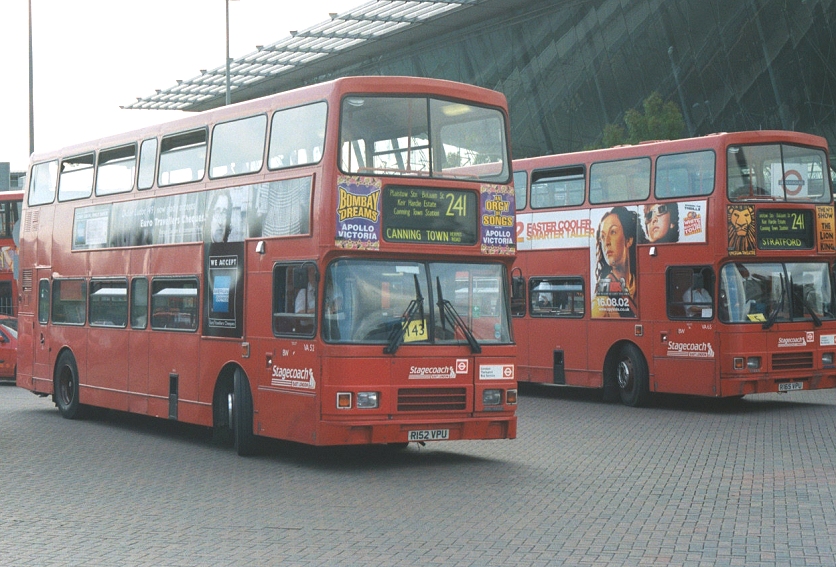
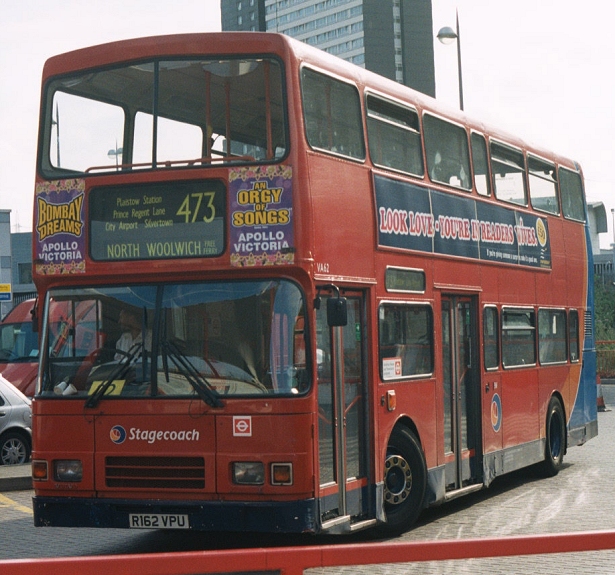
August 2002 at Stratford: Alexanders VA52 and VA65 are on the 241 to Canning Town. VA62 on the 473 wears the stylish rear-end "swoops" that were not to last long.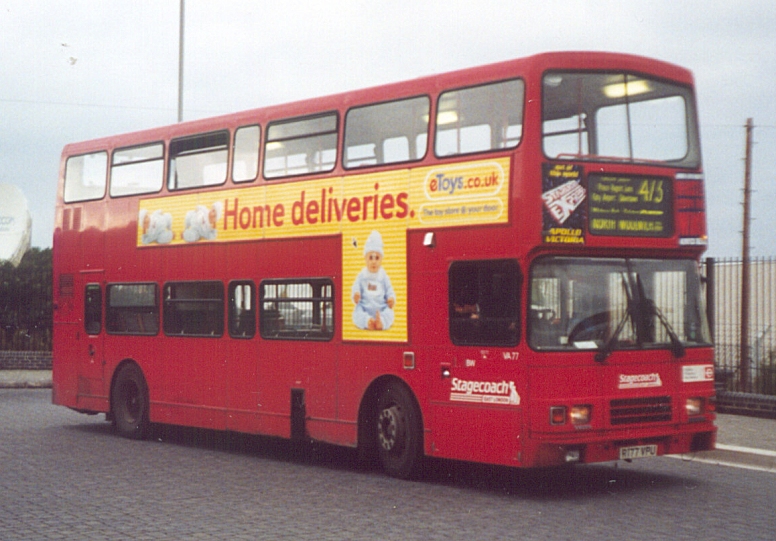
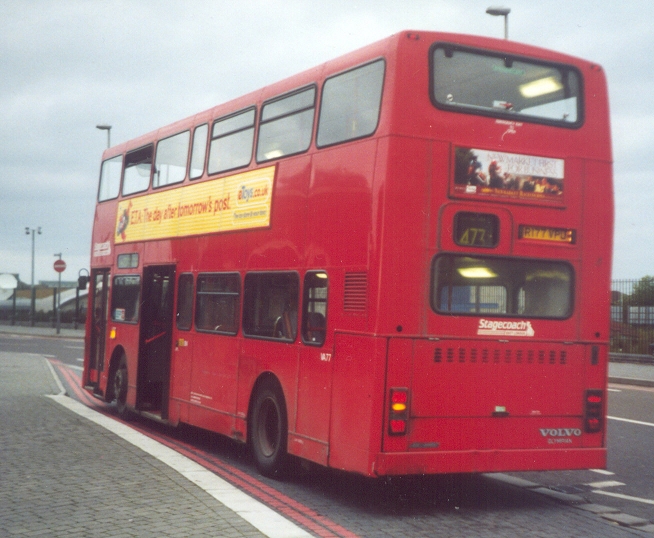
Two doorway stretched Alexander Olympian VA77 on the 473 at North Woolwich in October 2000.VN82-VN110: standards for CatfordCatford had been due a wholesale re-equipment with fifty long Volvos back in 1996, but the proposals had met Union resistance, and the buses went elsewhere. Now, in 1997 Catford received a batch of standard length (9.6m), standard height (4.3m) dual-doorway Palatine Is. They were for the 54 (West Croydon - Woolwich Arsenal), which Catford took over from Plumstead, and the 75, (West Croydon - Lewisham), which had been operated with Catford's Titans and Leyland Olympians.
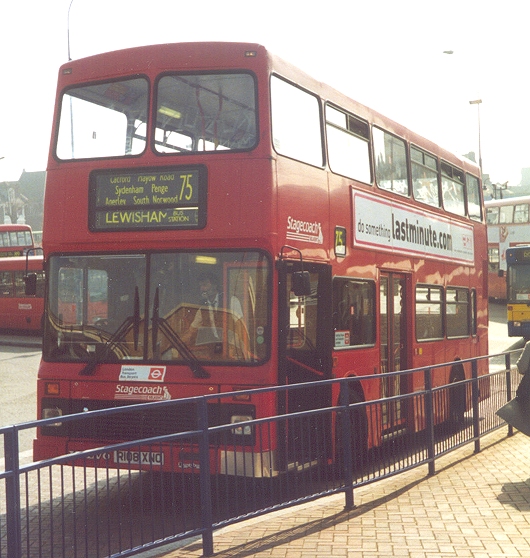
VN108 was enjoying the spring sunshine at Lewisham Bus Station between stints on the 75, March 2000.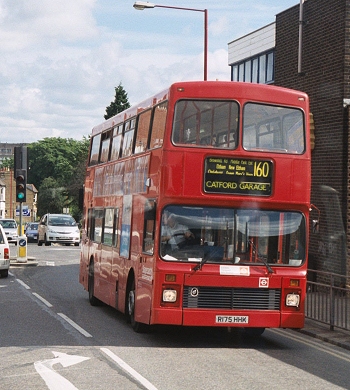
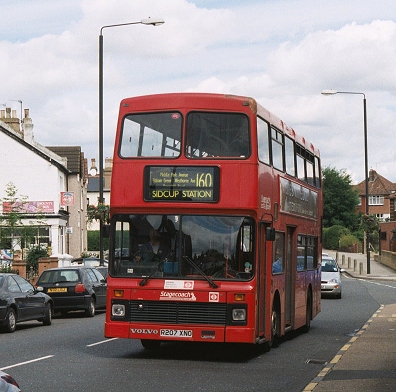
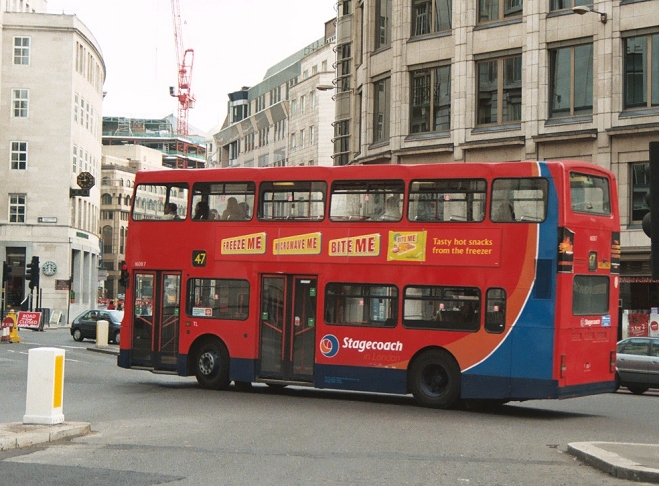
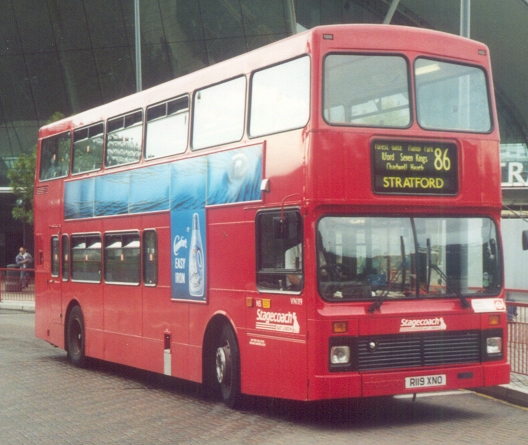
VN175 was typically on the 160 in Sidcup in June 2002, as was VN99 in Chislehurst. 16087 shows off the revised Stagecoach London livery in October 2003, on the 47 in the City of London.Short Tridents took over the 75 and 54 at Catford in the autumn of 2002, displacing twenty of the VNs to Plumstead, where they took over on the 96 (Woolwich - Dartford/Bluewater), 177 (Peckham - Themesmead), and 472 (North Greenwich - Thamesmead). But they only lasted there until the summer/autumn of 2003, when Tridents arrived to knock them off the 177. The Catford remnant hung on on the 47 until early 2004, when 16084 was the last in operation there.The entire batch was transferred to other Stagecoach companies all over the UK. VN111-VN121: more for RomfordThese eleven dual-doorway Northern Counties VNs arrived in May 1998 at North Street, where they completed the conversion of the 86 (Romford - Stratford ) begun with the VNs from Bow the previous year.
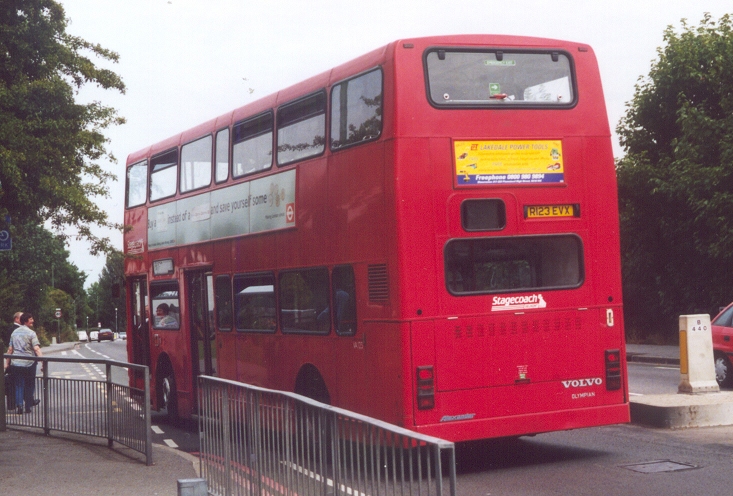
VN119 was on the expected route 86 in August 2000, when seen in Stratford Bus Station.Apart from VN113-4, which moved to Plumstead in September 2000, this batch stayed at North Street until early 2004, when almost a clean sweep of remaining step-entance buses saw them off to Stagecoach Bluebird in Aberdeen. The Plumstead two had already departed for Bedford and Peterborough in March 2003.VN122-VN148: Alexanders for Bromley and LeytonFifteen VAs came to Bromley in March 1998 for the 194 (Forest Hill - Elmers End - West Croydon) which they took over from Titans. A side effect was their appearance on the 320 turns to Westerham, where Titans had been experiencing problems on Westerham Hill. Most of these VAs stayed at Bromley. Even when the 194 was Tridented in September 2000 a bunch of VAs hung out at Bromley for the twice-a-schoolday duties on the 638, plus a pair for Surrey Schools contract routes 516 and 519. The Surrey schools services were re-awarded to the Olympians in September 2004, keeping this nicely painted pair in work at Bromley long after all the others had departed for pastures new. They (16122,16123) even received white roofs on repaint in summer 2005.
Stretched Alexander-bodied Olympian VA123 made an appearance when brand new at the Cobham Museum Open Day in April 1998. Three years later it was still at Bromley Garage, from where it sets off in June 2001.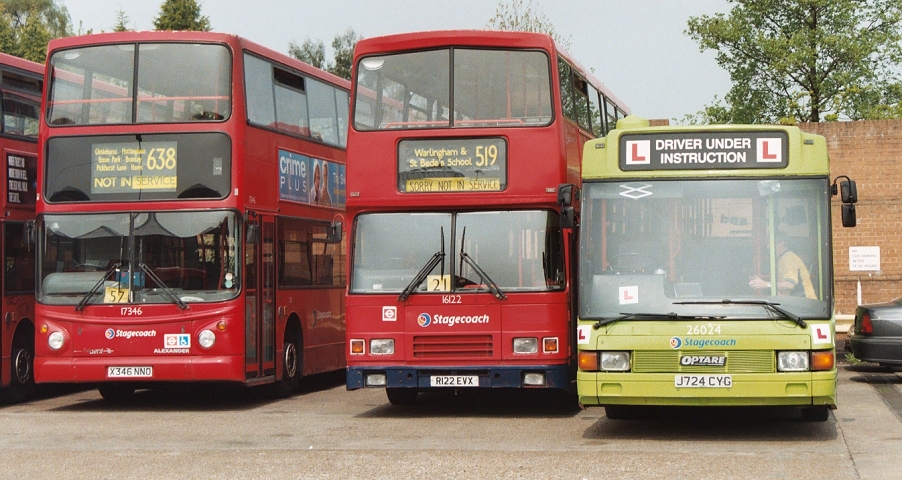
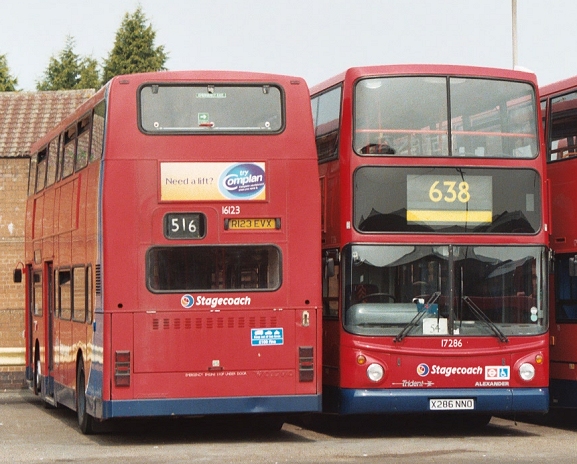
April 2004 at Bromley Garage: Alexanders 16122 and 16123 are kept for the 519, 516. Already Tridents have taken over the 638 school journeys. DA24 displays one of the training liveries.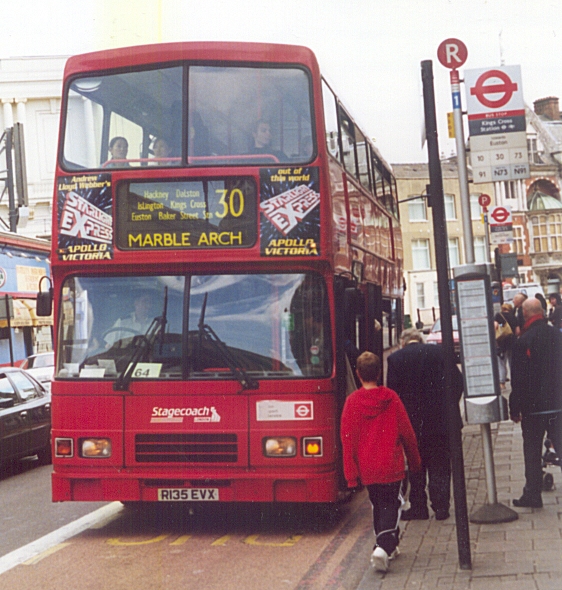 VN137-148 went new to Leyton, where they were put to work on the 48 (London Bridge Stn - Walthamstow Central Stn),
55 (Oxford Circus - Leyton) and 56 (Whipps Cross - St.Bartholomew's Hospital).
They were not there long before being hounded out by Tridents. They moved on to Bow in February 1999, or Bromley in early 2000,
then moved on to Stratford in April 2001, where they nominally worked the 26 but could be found on the 30 as well.
VN137-148 went new to Leyton, where they were put to work on the 48 (London Bridge Stn - Walthamstow Central Stn),
55 (Oxford Circus - Leyton) and 56 (Whipps Cross - St.Bartholomew's Hospital).
They were not there long before being hounded out by Tridents. They moved on to Bow in February 1999, or Bromley in early 2000,
then moved on to Stratford in April 2001, where they nominally worked the 26 but could be found on the 30 as well.
VA135 (SD) on the 30 at Kings Cross (September 2001).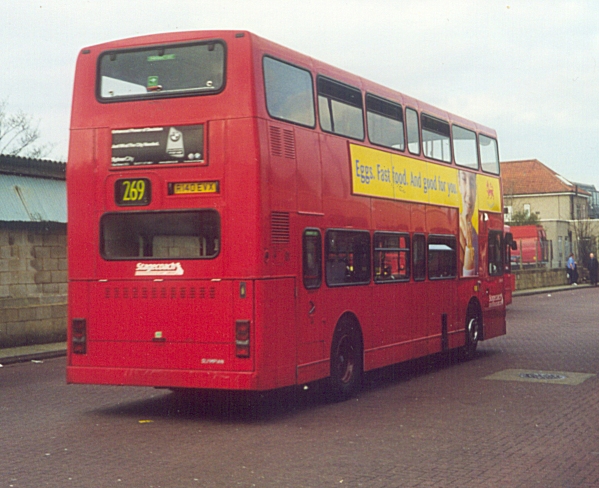

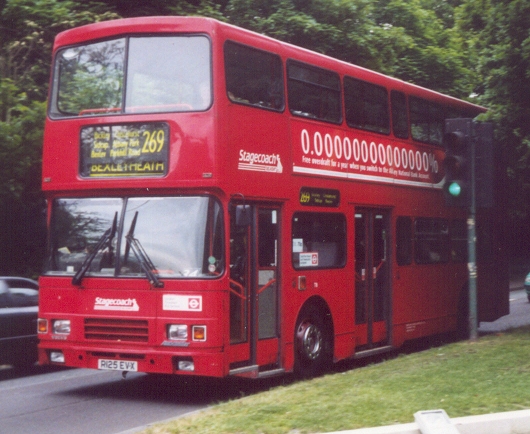
Stretched Alexander-bodied Olympians worked the 269: VA140 at Bromley North (March 2000) and VA125 at Chislehurst (June 2001).VN149-VN178: long NCs, also for LeytonThe last thirty were long low VNs, put into Leyton in May-June 1998 alongside VA15-148, also on the 48, 55, 56. They too were shoved out in the spring of 1999, all going to Plumstead for the 96, 177 and 472. They were all renumbered into the National scheme in January 2003 whilst with Selkent, becoming 16149-16178. With the usual loans/temporary transfers elswhere, they stayed at Plumstead until finally dispersed in 2003-4.
Stretched Northern Counties VN163 was employed by Plumstead on the 53, leaving Trafalgar Square in October 2001.
 Bus Stop Bus Stop
 Volvo index Volvo index
 Stagecoach Stagecoach
 bus histories
photo refs
Metrobus bus histories
photo refs
Metrobus
|