RTW 1-500 (Total 500)Introduced: May 1949
Chassis: Leyland PD2/3, 16ft 4in wheel-base, 6 cylinder 9.8 litre diesel.
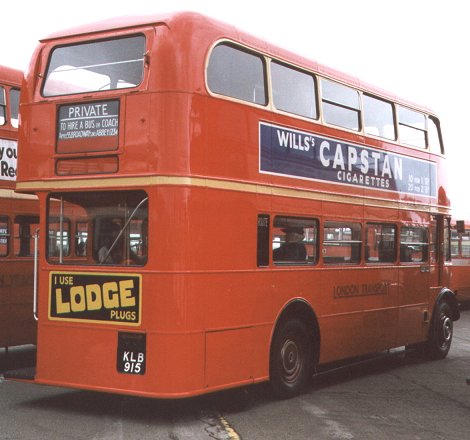
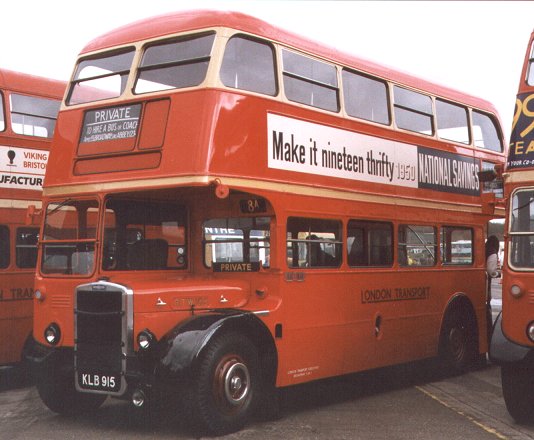
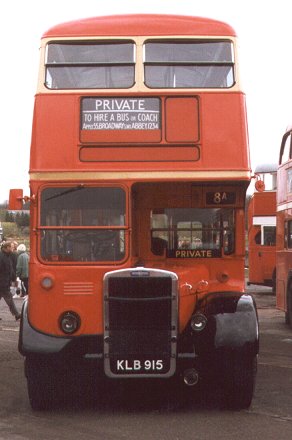
The RTWs had the distinction of being London's first 8ft wide motor buses. There had been 8ft wide buses in London Transport already, but those were trolleybuses, meant for South Africa, that were diverted to LT because of the war. They were banned from Central London and spent their days in the Ilford area. Similarly, the 8 ft Leylands were originally banned from Central London, and from anywhere with tram tracks, which limited their scope somewhat. The Metropolitan Police, scourges of public transport innovation, were only prepared to admit them as suburban buses. RTW185 wears the 1949 livery with cream around the upper windows, at Cobham Open Day, April 1998. Photos by Ian Smith. Click on images for larger versions.Into service in the suburbsThey appeared in 1949, the first at Tottenham (AR) in May, not for the famous 76 but for the 41, which came no further in than Archway. It took until August to stock the 41 completely.Then it was the turn of Alperton (ON), which took two dozen for the 187 in August and September 1949. Shepherd's Bush (S) and Hanwell (HW: later Southall) then stocked up for the 105. In October Leyton (T) took thirteen for the 144, followed by eight at Enfield (E) in November for the 144A, with West Green (WG) taking the next fifteen to complete these two routes. December saw them go to Palmers Green (AD) for the 112, south of the river for the first time to Putney Bridge (F) for the 85 and to Harrow Weald (HD) for the 140 and 142. The other garage on these two routes - Edgware (EW) - had to wait for the new year, but deliveries of RTWs continued to these two garages until April. Meanwhile deliveries has started to East London, with Upton Park (U) receiving them for the 129 and 145, Barking (BK) for the peak journeys 23B and 23C, and the longer 145 and 148, and Seven Kings (AP) for the 139, 147 and 148. In June Bromley (TB) received a contingent for the 119, 126, 138 group of routes, but they were not to stay there very long! (I don't remember seeing them at all, but I was only two at the time!)
The width-trials in Central LondonThe ban on the use of wide buses in the central zone had arisen because of fears of accidents and congestion in some of the narrow streets of London. To convince the Public Carriage Office that the fears were groundless, LT persuaded them to permit an experiment. A single bus experiment would not work, as the fears concerned passing on corners, so eight whole routes passing Notting Hill Gate were swapped from RTs to RTWs for a week in May 1950. This involved the Sunday exchange of 306 RTWs to strange garages! RTWs went to Elmers End (ED) and Nunhead (AH) for the 12; to Hammersmith (R) for the 17; to Holloway (J) and Twickenham (AB) for the 27A; to Middle Row (X) and Putney (AF) for the 28; to Battersea (B) and Chalk Farm (CF) for the 31; to Willesden (AC) for the 46; to Willesden and Victoria (GM) for the 52, and to Merton (AL) and Hammersmith for the 88. Merton, which had no RT family buses to swap, received mainly new RTWs for the trial. After working Monday to Friday the buses were returned.
Following straight on was the third test, centred on Threadneedle Street in the City for a week. Willesden (AC) gained RTWs for the 6, 6A, 8 and 8A; Hackney kept its test buses for the 6, 6A and 22; Clay Hall (CL) had them for the 60 as well as the 8, 8A, and Battersea kept some for a share of the 22. The trials brought RTWs to High Holborn on the 8, 8A and 22. On a damp December night in 2002 preserved RTW467 was back there for a tour of the West End lights. Photo by Ian Smith.The experiments were a success, and the RTWs were henceforth allowed in the Central zone. They were still banned from sharing routes with trams, which cut out much of south-east London, but in the West End and City they were now welcome. Here their extra width would be very beneficial in allowing freer and faster circulation in the downstairs gangway. On busy Central London routes this was significant. The proposed allocations of new buses during the rest of 1950 were amended to match the new policy. More new buses: the second half of 1950Southall (HW) was no stranger to RTWs (as Hanwell garage), and received a further batch in the last third of 1950 for the 92 and 92A. Likewise Harrow Weald (HD), which replaced STLs and the disliked SRTs from the 114. These were vestiges of the pre-trials plans, too advanced to change at short notice. In September RTW421 and RTW422 travelled to Berlin to represent London Transport and Leyland at the German Industries Fair. The new order for RTWs at home began in September: Putney Bridge (F) replaced its mix of STLs, war-time RTs and new RTs on the 74 with new RTWs, which saw the wider buses skirting the West End for the first time. After that Battersea and Chalk Farm gained allocations for the 31 and 39, displacing RTLs which took RTWs into the heart of the West End.
1951: RTW Migration to the Centre
January 1951 saw no major changes in the RTW fleet as such,
but was significant in that a large chunk of the tram network was swept away,
paving the way for RTWs to venture into south-west London more readily.
February 1951, however, saw a large movement towards the centre.
The isolated RTW contingent at Bromley, after only six months there,
was swapped with RTs from Willesden,
and took up residence on the 8 and 8A - two of the trials routes.
The Clay Hall contribution was obtained by sweeping Palmers Green clean of RTWs in exchange for RTLs,
plus a contribution gleaned from Seven Kings' 139 route.
The new order in Central London in 1951, as the 8 and 8A were converted for 8ft wide buses. Preserved RT185 and RTW497 demonstrate the 1949 and 1950 liveries worn by new RTWs, and the difference between the austerity restricted blind displays and the restored postwar full displays.Enfield lost its small batch in March, to boost capacity at Putney Bridge.April saw even more changes, with the conversion of the famous route 11 plus the 6 and 6A. For Dalston's large share of the 11 all the RTWs were drained from Leyton and Upton Park, with a large contribution from Harrow Weald, plus some from Putney Bridge. Riverside (the erstwhile Hammersmith, R) gained its share for the 11 also from Harrow Weald, as did Willesden and Hackney for the 6 and 6A. This wiped Harrow Weald clear, and still left a deficit. So Edgware swapped some of its RTWs to Riverside, plus some to Putney Bridge to restore its allocation. All these buses were replaced by RTs or RTLs from the garages involved, or through three-way swaps to keep RT and RTL allocations separate.
No, not Tottenham in 1951, but East Grinstead in April 2002. RTW185 visits the Running Day, wearing 76 blinds.August 1951 saw the 22 re-equipped with RTWs, at Hackney and Battersea, the buses coming from Seven Kings, Southall and Barking, who got RTLs in return. Southall lost its remainder later in the month, in company with Alperton and Shepherds Bush, when Upton Park had its second go with RTWs, this time with an enormous number for the 15.Now only Edgware was using RTWs on purely suburban duties, and from October 1951 these were dispersed to the other RTW garages as and when replacement buses became available. The transition from suburban wide-boy to central urban crowd-shifter was complete.
Through the rest of the fifties they provided a distinctive touch to central London. We didn't get these in the suburbs any more. They were a little different, a touch exotic - and very much at home on the Capital's busiest routes. New tasks came their way as the fifties progressed. Withdrawal of the wartime RTs from Putney Bridge in February 1955 brought replacements for route 14 in the shape of RTWs scraped together from surpluses around the fleet. 1958 saw a contraction in bus provision throughout the fleet, especially after the strike. Enough RTWs became available through the re-entry to service of the works float at the end of the overhaul round for Chalk Farm to convert route 24 to RTW operation. Also, in November, the big shakeup implementing service reductions after the strike saw Walworth (WL) became an RTW garage, the first ex-tram depot to do so, for the 45, 176 and 176A. Middle Row (X) also took over route 18B from Willesden, along with its RTWs, but this allocation was short-lived: the RTWs went off to Walworth ten months later. Putney Bridge (F) closed, with its RTWs transferring next door to Chelverton Road (AF). November 1959 saw RTWs go to an ex-trolleybus depot for the first time, when Clay Hall closed, the RTW allocation and routes transferring to nearby Bow (BW). April 1960 saw some on trolleybus replacement route 123, from Tottenham garage, operating alongside Routemasters.
Replacement by newer eight-footers
Once the Routemasters had completed their first task of displacing the trolleybuses in 1962
they inevitably started to displace the RTWs from the high profile Central routes.
Putney's allocation on the 14 was replaced in October 1963.
RTWs took up new duties on route 95, working from Brixton (BN).
November saw large-scale displacement from the 24,
with the high-numbered Chalk Farm buses largely being spread around the other RTW garages,
in turn displacing low-numbered examples into the training fleet all over London:
wide Leylands replaced green Leylands in the training fleet!
Early 1964 saw them replaced on Tottenham's 123 and 41, where presumably they compared badly in the public's eyes with their RM colleagues. They went too from Upton Park's 15 and interworked 100, in April, moving to Brixton for the 109. In 1965 many were displaced by RTLs, and then by RMs, at Bow (8, 8A), Willesden (8, 6, 6B, 33, 46, 176), Hackney (6, 6A), Riverside (11), Battersea and Chalk Farm. Early in 1966 they disappeared in droves - from Chalk Farm (45, 31), Walworth (45), Hackney (106), Dalston (11), Riverside (11), Hackney (22). They remained only at relative newcomer Brixton, where they survived until May on the 95 and 109. Last day of passenger service was 14th May 1966, with RTW467 the last to run in. RTW467 was the last to run in ordinary LT passenger service, in May 1966, but happily was bought for preservation. Here it rests under London Bridge Station in December 2002, on the RT-RF Register's Christmas Lights Tour.Ideal TrainersBut the RM programme brought a new niche for the RTWs. Being 8 ft wide they made ideal trainers for drivers who would have to manoeuvre the RMs through City and suburban streets. So many went into the training fleet and stayed there while the RMs, followed by Merlins and Swifts, sent RTLs and RTs into oblivion. Even Country Area garages used RTWs as trainers - RMCs, RCLs and RMLs were 8ft wide too - but they retained their red livery. 130 RTWs were maintained in the training fleet from 1966 onwards, but in 1969 the decision was made to standardise the training and staff bus fleets on RTs to alleviate the worsening spares situation. The RTW trainers started to disappear in late 1969, heading to Wombwell Diesels in Yorkshire. The Country Area trainers returned in December 1969, just before the split-off to London Country, although they Country Area used them to the last gasp: some were even allocated outwards to the country for a brief period in December. But even in the Central Area they were going, and during 1970 the last went into store, even the Chiswick skid bus, and the very last - RTW185 - was sold in May 1971, fittingly for preservation.After LondonThe first RTWs sold by LT during 1965 went to dealers - Bird's of Stratford and Ridler of Twickenham - but three went to Niagara Falls in Canada and four went to Cape Electric Tramways in South Africa. After that over half the class (279) were sold to the Crown Agents on behalf of the Ceylon Transport Board for export to Ceylon (Sri Lanka). In 1969 UK Sales resumed, mainly to Yorkshire scrap dealers. Some buses were sold on to bus companies: Stevensons of Spath, Barton, and A1 Service were all users, and some were used by a variety of contractors and companies as staff transport or as showrooms.Preserved RTW29 at Cobham Open Day 1999.
Comparison of the rear views of RTW29 and RTW185 will show a difference in gutter arrangements above the rear window.
RTW185 has the Leyland version, with an upturn on the nearside,
whereas RTW29 has the later LT modified version without the upturn.
Friday 4th June 2004 saw the extraordinary spectacle of two RTWs working in public service in London on the same day.
The occasion was the last day of Routemaster operation by Stagecoach London,
and many guest buses worked in service on Route 8 between Victoria and Bow Church.
Amongst the throng were privately preserved RTW467, the last to work in service 38 years previously,
and RTW75, newly restored by Blue Triangle and fresh from its MOT that day!
|