Prepared on Notepad by Ian Smith,
This page created 15th December 1998, updated 1st January 1999

The ex-BEA Routemasters
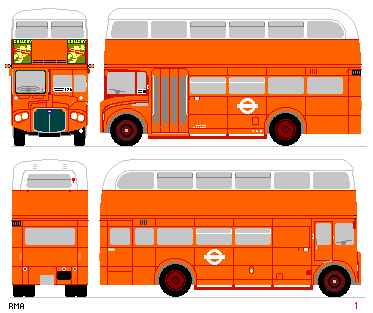 When London Transport bought the first thirteen coaches from BEA in August 1975
(for just £3000 each!) LT was desperately short of functioning rolling stock.
Their forward entrances, doors, high gearing and semi-automatic gearboxes
made them unsuitable for City work (it was thought),
but a niche was perceived in the suburbs:
the 175 between Dagenham and North Romford.
When London Transport bought the first thirteen coaches from BEA in August 1975
(for just £3000 each!) LT was desperately short of functioning rolling stock.
Their forward entrances, doors, high gearing and semi-automatic gearboxes
made them unsuitable for City work (it was thought),
but a niche was perceived in the suburbs:
the 175 between Dagenham and North Romford.
The purchased buses made a quick visit to Chiswick for a few essential additions
for bus work: bells, ticket boxes, a docket for the conductors way-bill, and
removal of the hand-luggage rack acroos the rear of the saloon.
Red paint was not deemed essential,
ownership being displayed by white roundels
(plus the legal lettering of course).
Nor were destination blinds!
Perhaps the expense of these could not be justified
for buses that might be flatly rejected anyway.
Prospective passengers had to glean information from a slipboard inside
the slanting front saloon window.
Some buses received adverts, others retained the British Airways ads.
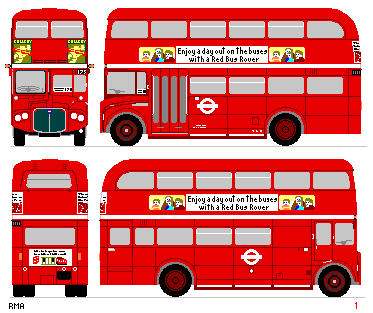
The "new" buses, classified RMA, were numbered in order of registrations,
using white registration letters - no expense spared!
They went into service on the 175 in mid-October 1975,
but were not very popular.
The lack of internal stanchions was a drawback for both staff and passengers,
while the lack of destination information was a nuisance.
One by one they went to Aldenham for a repaint into red,
and for the fitting of a route-number box under the canopy,
but the last few had not returned to service before they were all withdrawn
from the 175 in September 1976.
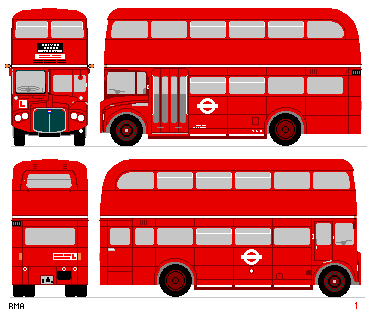
LT was now thinking of using them as trainers.
The problem was the staircase,
which prevented the instructor sitting behind the trainee driver in the usual way.
Simple! : remove the staircase and install a seat, window and emergency brake valve.
This was done on three of the RMAs (5, 4 and 3) during the autumn and winter of 1976-7.
Although it had been the intention to convert all the first batch,
this never happened, although a further seven (from the third batch bought)
were converted in spring 1981.
The change in heart was probably a result of the mass purchases from London Country,
which assuaged the immediate need for trainers.
Meanwhile LT bought another 14 BEA RMs when they became available in November 1976,
and stored them, along with the other ten of the first batch,
until it decided what to do with them.
The decision eventually was to use them as staff transport to and from Aldenham and Chiswick works.
When Aldenham had been set up as the "central" works for LT,
right out on the north-western perimeter of London,
staff transferred there had been guaranteed transport.
So each day the buses sped across London from every corner,
carrying the work-force.
All sorts of buses had been used: STLs, the Leyland STDs, RTLs, RTs, MBs
even GSs from the far side of London at Plumstead and Abbey Wood!
The RMAs, with their higher gearing and doors, were ideal for this.
The lack of destination equipment was not a problem either,
as a slipboard in the drivers window saying
whither it was bound was all that was needed.
They travelled to and from all parts of the old London Transport system,
including those now hived off to London Country.
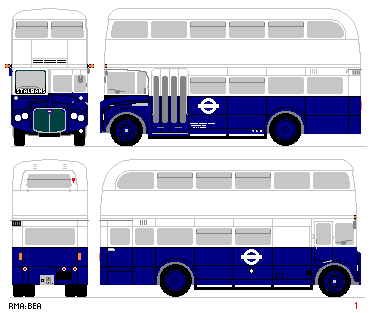 So from February 1978 the RMAs were pressed into staff bus service.
At first the second batch (RMA14-27) were used,
mostly still in British Airways blue and white with roundels added.
From April onwards they were joined by the first batch in red.
So from February 1978 the RMAs were pressed into staff bus service.
At first the second batch (RMA14-27) were used,
mostly still in British Airways blue and white with roundels added.
From April onwards they were joined by the first batch in red.
They were joined by the remainder of the BEAs when British Airways
stopped using them in 1979.
London Transport bought these for just £2000 each, although not all were runners.
Some were not needed immediately, and went into store,
emerging once the trainer rebuild programme was resuscitated,
and some never did work for LT.
It was September 1980 before a repaint programme started
to get the staff buses into red,
and some buses continued in blue and white until 1984!
The unused buses were inspected in early 1981, and eleven RMAs were sold,
still in BA colours. Another four, used for a while, were also sold then,
followed by more as time passed.
But Aldenham was in decline, with a diminishing work-force.
The need for staff buses dropped commensurately.
Aldenham, along with Chiswick, was separated from the bus operating business
by the formation of LRT Bus Engineering Limited in April 1985,
but the writing was clearly on the wall: Aldenham closed in November 1986,
after its remaining work had been transferred to Chiswick.
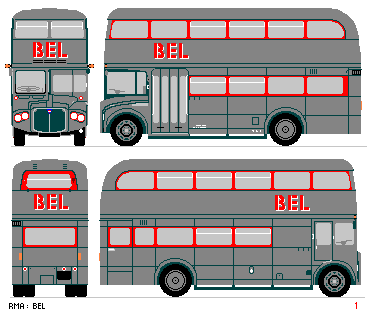 BEL had inherited 34 of the RMAs, most of which it no longer needed.
Some were repainted into a medium grey, quickly amended with red window surrounds
and BEL logos. Even though they were supposed to operate in the off-hours,
as staff trtansport, they were not an inspiring advert for a thriving bus engineering company.
What the staff thought, trying to spot a dark grey bus on a wet winters morning in the dark,
is best left to the imagination. It could almost be described as a death-wish livery.
But it did not last long. BEL found that its remaining staff-bus needs could be met by minibuses,
so the remaining RMAs were sold.
The last staff bus run was on December 17th 1987, to St Albans,
by RMA 16.
BEL had inherited 34 of the RMAs, most of which it no longer needed.
Some were repainted into a medium grey, quickly amended with red window surrounds
and BEL logos. Even though they were supposed to operate in the off-hours,
as staff trtansport, they were not an inspiring advert for a thriving bus engineering company.
What the staff thought, trying to spot a dark grey bus on a wet winters morning in the dark,
is best left to the imagination. It could almost be described as a death-wish livery.
But it did not last long. BEL found that its remaining staff-bus needs could be met by minibuses,
so the remaining RMAs were sold.
The last staff bus run was on December 17th 1987, to St Albans,
by RMA 16.
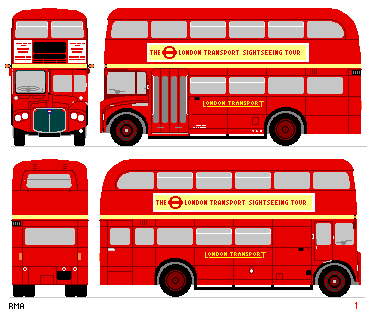 Meanwhile, at the end of 1986, a batch of six BEL RMAs (15, 22, 25, 26, 51, 65)
were bought back by London Buses for the London Sightseeing Tours.
Their repaint into traditional London Transport red,
with cream band and traditional fleetname,
was part of Aldenham's last work for London Buses Ltd.
Other work, at Chiswick, included an overhaul and renewal of the seat moquette,
as well as fitting of PA equipment, and - at long last - front blinds!
They performed sightseeing duties, and were privatised with London Coaches in 1992.
They received the new livery, but were put up for sale at the end of the 1993 season.
One was sold privately, and the other five went to Blue Triangle,
who sold on three to Ireland and stored two.
Meanwhile, at the end of 1986, a batch of six BEL RMAs (15, 22, 25, 26, 51, 65)
were bought back by London Buses for the London Sightseeing Tours.
Their repaint into traditional London Transport red,
with cream band and traditional fleetname,
was part of Aldenham's last work for London Buses Ltd.
Other work, at Chiswick, included an overhaul and renewal of the seat moquette,
as well as fitting of PA equipment, and - at long last - front blinds!
They performed sightseeing duties, and were privatised with London Coaches in 1992.
They received the new livery, but were put up for sale at the end of the 1993 season.
One was sold privately, and the other five went to Blue Triangle,
who sold on three to Ireland and stored two.
The trainer RMAs gradually fell by the wayside,
but two of the Stagecoach East London trainers, RMA5 and RMA8,
were given a new lease of life when their staircases were restored
and they returned to passenger duties.
They were used for hire work, rallies, and turns on route 15.
In 1998 they were converted for right hand drive,
with reversed doorway and stairs,
and exported by Stagecoach to their Portugal business.
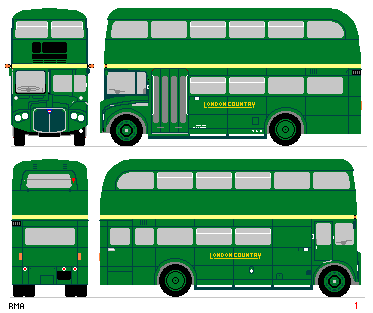 Other dispersed RMAs had interesting histories of their own.
Other bus companies did not have the same reservations about them that London had had,
and put them to work carrying passengers. They appeared from the South Coast of England
to the cities of Scotland, in a gaudy variety of liveries.
RMA16, after a period on Clydeside, was transferred south to London & Country
and appeared in traditional Country area green with a cream band!
(Arriva's changed corporate attitude has since resulted in the loss of this one to Sweden)
Most of the RMAs have now fallen by the wayside, or are in preservation.
If you see one on sightseeing duties, as a few still are, go for a ride!
Other dispersed RMAs had interesting histories of their own.
Other bus companies did not have the same reservations about them that London had had,
and put them to work carrying passengers. They appeared from the South Coast of England
to the cities of Scotland, in a gaudy variety of liveries.
RMA16, after a period on Clydeside, was transferred south to London & Country
and appeared in traditional Country area green with a cream band!
(Arriva's changed corporate attitude has since resulted in the loss of this one to Sweden)
Most of the RMAs have now fallen by the wayside, or are in preservation.
If you see one on sightseeing duties, as a few still are, go for a ride!
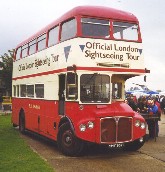
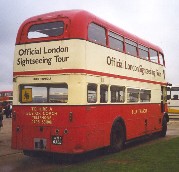
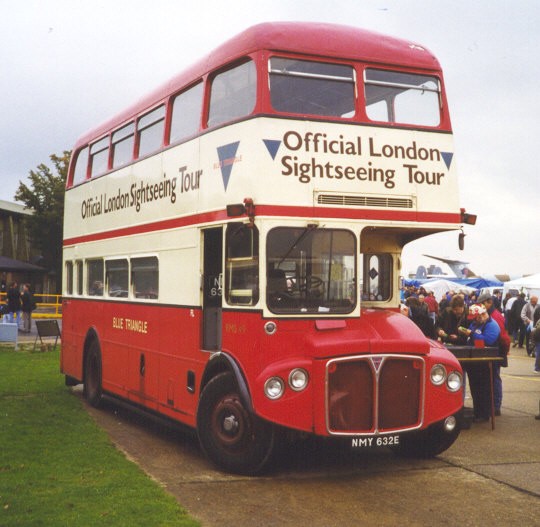
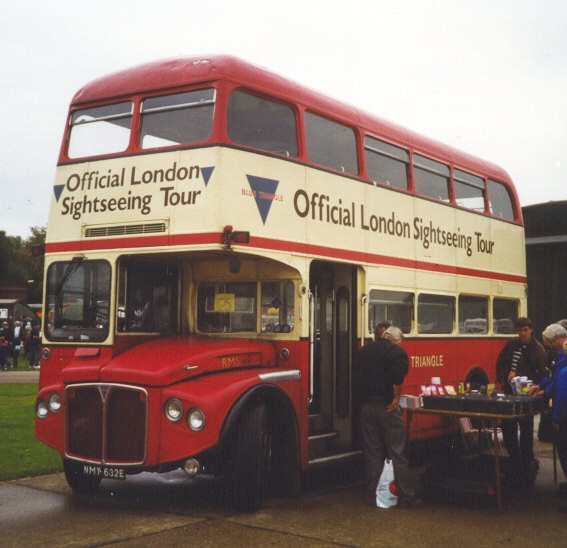
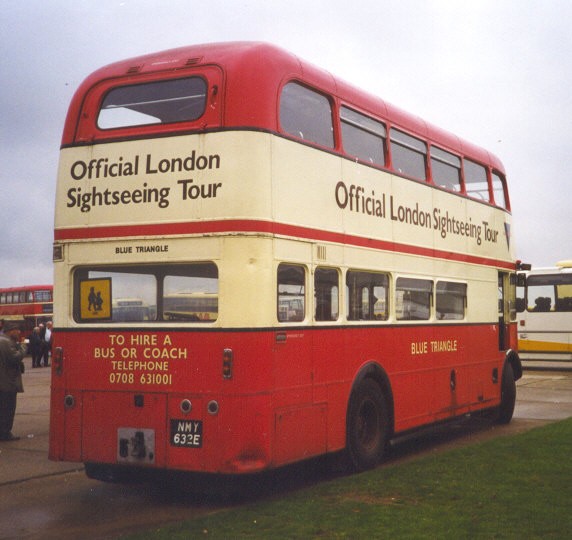
RMS 49 has been with Blue Triangle of Rainham
since it was acquired from London Transport in October 1982.
LT had bought it from BEA in June 1979 but did not use it.
Blue Triangle operated it in London on sightseeing tours,
but retained it for contract work and rallies when they sold the tour operation.
RMS49 is seen here at Duxford, at the 1998 Showbus.
Photos by Ian Smith: click for larger, clearer versions.
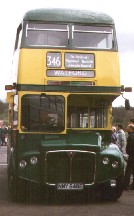
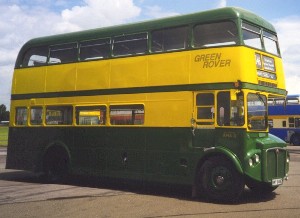
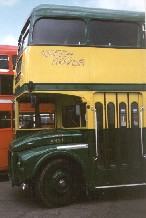
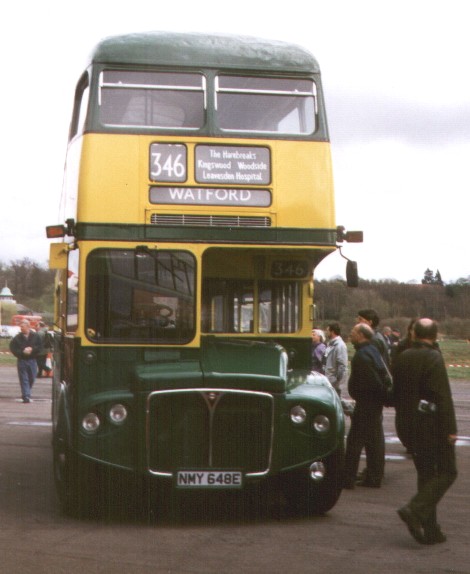
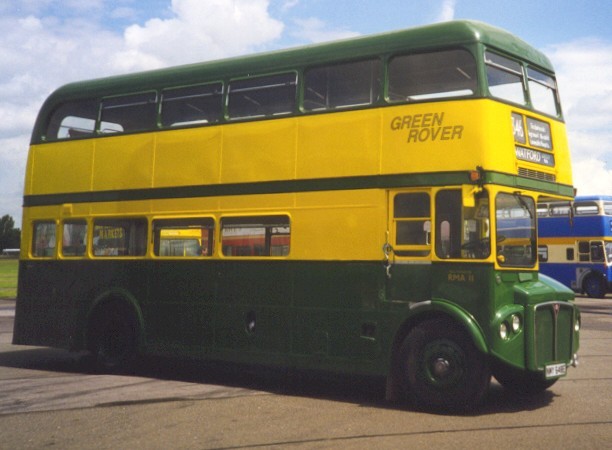
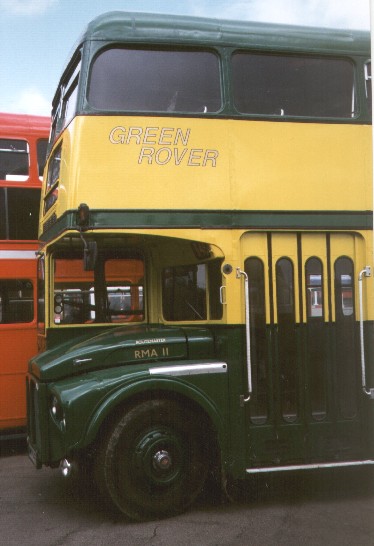
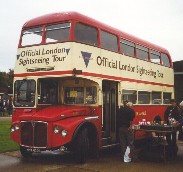
RMA11 was one of the first batch bought by LT from BEA,
and was used briefly on the 175 in 1976. After a red repaint, and a period in store,
it became an Aldenham staff bus. Sold by BEL in early 1987,
it saw passenger work with Verwood Transport in Poole,
before being acquired for preservation.
It operated again, for the Green Rover operation at Watford,
and received this attractive livery just as the operation ceased.
RMA11 is seen here in preservation, at Brooklands for the 1998 Cobham Open Day, and at North Weald.
Photos by Ian Smith: click for larger, clearer versions.
The bus histories are on a separate page,
as are the photographic references
 Ian's Bus Stop Ian's Bus Stop
 RM Contents.
 BEA RMA
 LT RMA
 FRM
FRM
|