The London Buses Nationals: LS
This page created on 10th February 2000
by Ian Smith

- National buses
- Red Arrows: National 2s
- Tenders and Privatisation
- LSLs
Part Three: Tenders and Privatisation
By the second half of the 1980s the London Nationals were being squeezed out of jobs in the capital.
Competitive tendering was now the thing, under the London Regional Transport regime,
with London Buses having to compete with other companies to operate London routes.
It was not deregulation and unbridled competition as was happening elsewhere in the UK.
This was heavily regulated competition, but none the less cut-throat for that.
The P4 route, freshly converted to London National 2s was an early casualty,
going to London & Country - who used their own Nationals on it!
Then in May 1986 Loughton's routes were lost
- and Loughton was an all-National garage.
London LS Nationals appeared on the flourishing second-hand bus market,
and were snapped up like hot cakes. They were well cared for, middle-aged,
and above all familiar to bus engineers across the land.
Some fleets took sizeable numbers, including Eastbourne Buses, Parfitts of Rhymney Bridge,
Thames Transit, Maidstone Boroline and British Airways (the latter for airside use).
Many others took penny numbers, but the ex-London Nationals became a familiar sight,
some still operating in London red, with just the bullseye painted over and the legal lettering changed.
 In the London Area some low-cost units were set up in an attempt to fight off the competition,
such as Harrow Buses, which operated Nationals in red and cream,
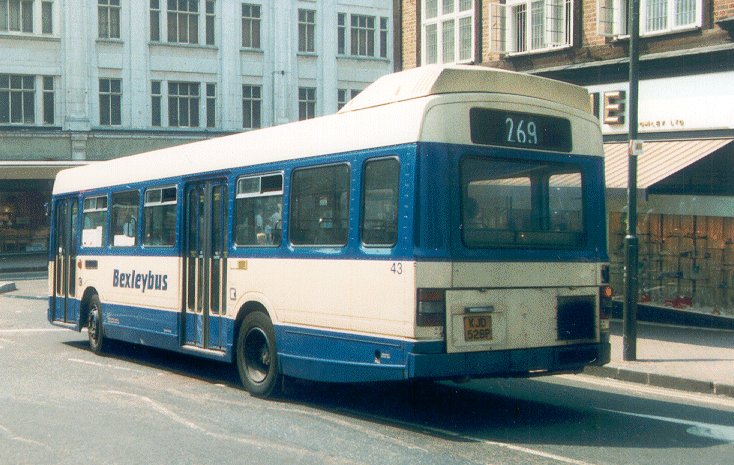
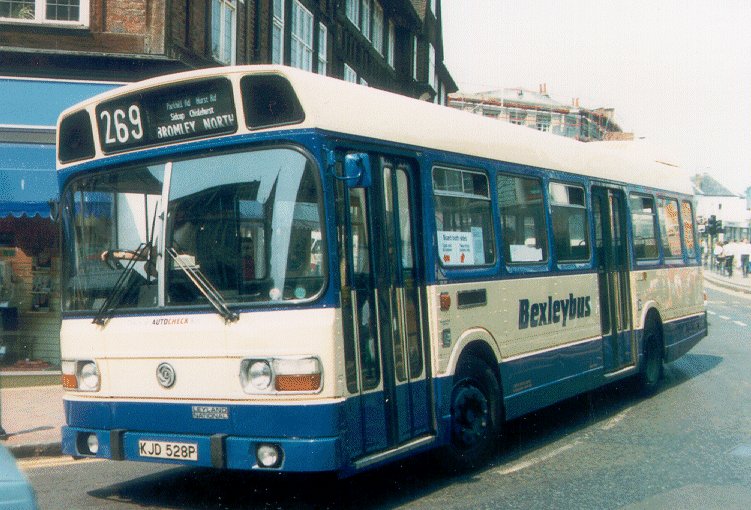
and Bexleybus, in blue and white.
At the end of 1987 a collection of Nationals were despatched to Eastbourne Buses for repaint
(it was Eastbourne Buses' colour scheme), ready for service from January 1988. Bexleybus proved a short-lived disaster:
having obtained tenders on the basis of reduced staff costs,
the unit found itself without crews to operate the buses
and after a period of appalling reliability
understandably lost the next tender round.
In the London Area some low-cost units were set up in an attempt to fight off the competition,
such as Harrow Buses, which operated Nationals in red and cream,
and Bexleybus, in blue and white.
At the end of 1987 a collection of Nationals were despatched to Eastbourne Buses for repaint
(it was Eastbourne Buses' colour scheme), ready for service from January 1988. Bexleybus proved a short-lived disaster:
having obtained tenders on the basis of reduced staff costs,
the unit found itself without crews to operate the buses
and after a period of appalling reliability
understandably lost the next tender round.


Bexleybus 43, alias LS528, rounds Bromley Market Place on the 269,
on the last lap of its trip to Bromley North Station.
Photos, used with permission, by Mark Dale. Click for larger versions.
Hillingdon Council replaced its BLs on route 128 with three Nationals (LS222, 236, 240)
in July 1988, repainted into the special livery of red and yellow with prominent lettering and green blinds.
 Another nail in the National coffin was the midibus revolution.
From 1988 onwards the fashion in London Bus circles was the small frequent bus
manned by drivers on lower pay rates, that could get to places real buses couldn't go.,
or which could generate traffic by their frequency.
There were Mercedes and Renaults and Metroriders.
Then there was the Dennis Dart. London Buses invested heavily in short
Darts in 1990, and for a while they took over nearly everything
apart from the really heavy duty flows.
Leyland Nationals were neither small and nippy,
nor large enough for long trunk flows.
They left for places they would be appreciated, all over the country.
Another nail in the National coffin was the midibus revolution.
From 1988 onwards the fashion in London Bus circles was the small frequent bus
manned by drivers on lower pay rates, that could get to places real buses couldn't go.,
or which could generate traffic by their frequency.
There were Mercedes and Renaults and Metroriders.
Then there was the Dennis Dart. London Buses invested heavily in short
Darts in 1990, and for a while they took over nearly everything
apart from the really heavy duty flows.
Leyland Nationals were neither small and nippy,
nor large enough for long trunk flows.
They left for places they would be appreciated, all over the country.
Those that remained were given a new London Buses livery at repaint. The bumpers went grey, and were complemented by a grey mini-skirt.
A white tape-line improved the cant-rail, and local district names (London Forest, East London, London United....)
graced the cantrails and dash in discrete white letters.
Privatisation
Westlink
 Stanwell Buses, operating as Westlink, was one of the first units to be actually sold off from London Buses,
in January 1994. It took with it Hounslow Heath and Kingston garages,
and a cluster of routes in traditional single-decker-land
around the Thames west of London. It was a faithful user of Nationals.
Stanwell Buses, operating as Westlink, was one of the first units to be actually sold off from London Buses,
in January 1994. It took with it Hounslow Heath and Kingston garages,
and a cluster of routes in traditional single-decker-land
around the Thames west of London. It was a faithful user of Nationals.
Livery initially was an uninspired basic red with a band of white and turquoise stripes, like a streak of toothpaste. This was later upswept at the rear.
Westlink had been bought by a management team in January 1994. They were taken over by West Midlands Travel group in March 94.
They too were enthusiastic National users in their companies dotted round the UK,
and some of the Westlink LSs went on transfer, temporarily or permanently.
National Express bought West Midlands Travel in April 1995,
and sold off the Stanwell Buses company in September 95 to London United.


Westlink Driver trainer LS363 at Hyde Park Corner, June 1998.
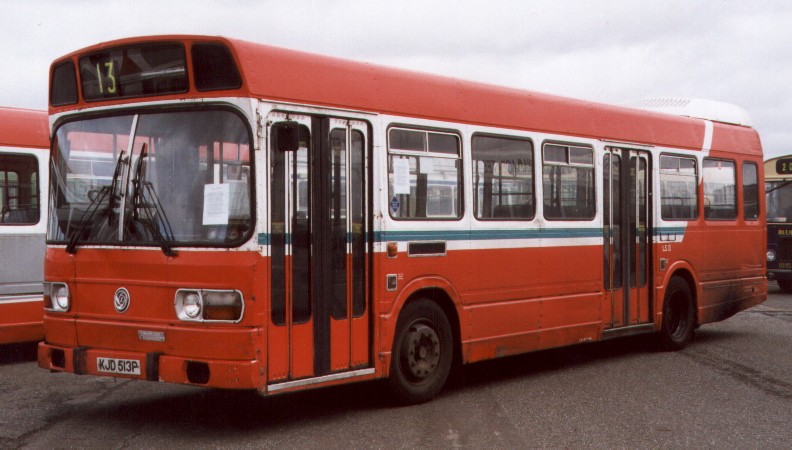
Preserved companion LS13 was at the Cobham Open Day in April of the same year..
 Since 1995 the Westlink and London United fleets have tended to merge,
with some ex-Westlink vehicles re-appearing in London United colours.
But others, including the ex-Docklands buses with coach seating
have received a repaint as Westlink dual-purpose buses,
including oldest London in-service survivor LS7.
Since 1995 the Westlink and London United fleets have tended to merge,
with some ex-Westlink vehicles re-appearing in London United colours.
But others, including the ex-Docklands buses with coach seating
have received a repaint as Westlink dual-purpose buses,
including oldest London in-service survivor LS7.

London United
London United left the London Buses fold by another management buy-out,
in November 1994.
With a West London base in Fulwell, Hounslow and Shepherds Bush
it was not surprisingly another company orientated towards single-deckers.
It took nearly two hundred Dennis Darts from London Buses,
but has welcomed the return of Nationals with the acquisition of Westlink.
Some have been refurbished to Urban Bus standards, with a single door,
38 seats, DipTac fittings and standard London United livery,
which suits them well.

Centrewest
Centrewest, privatised to a management team in September 1994,
had ten or so National 2s for the 607. They were fitted with replacement Volvo engines.
In April 1997 they were all withdrawn.
Six re-emerged at Centrewest as dedicated trainers,
in a bold red/yellow livery advertising driver training!.
The others went to other happy homes, including City of Oxford and Ensign Bus.
London General
London General inherited the 42 short Greenway GLS conversions,
and three unconverted National 2s. These latter were sold to Wycombe Bus in February 1997.
MTL London Northern
London Northern, bought by the Liverpool-based MTL group in October 1994,
inherited four National 2s. These were transferred north to Liverpool in mid 1995.

The Shires
This may seem an unlikely company to feature on this page,
but The Shires - based in the London Country North West area,
and a direct descendant of Luton & District,
bought nine third-hand (at least) National 2s from Parfitts of Rhymney Bridge,
in 1995. Pressed into service still in Parfitts livery,
they were repainted in The Shires' vivid blue and yellow livery and allocated to Dunstable.
Some were still at work in 1999.
Kentish Bus / Arriva Kent Thameside
Kentish Bus operated three Nationals on behalf of London Regional Transport
as Mobility Buses: LS202, LS290 and one LSL,
all fitted with wheelchair lifts and in London red livery.
In 1993 Kentish Bus bought the buses, and continued to use them on Mobility services.
Arriva Kent Thameside retired them in April 2000.

Capital Citybus
London Regional Transport allocated the three National Mobility Buses, LS 356, 396 and 454
to Capital Citybus to operate on its behalf.
When the Mobility Bus contract expired and passed to other types of small bus,
Capital Citybus bought the National 2, LS454, and converted it back to standard bus configuration, with a single door.
Capital Citybus operated a small number of other second-hand Nationals,
mostly from other parts of the UK, but including LS175 and LS288 ex-London Buses,
converted to single door and upseated.
They even painted a bendi-bus National (ex British Airways) into Capital Citybus yellow/red,
with Red Arrow markings and blinds as an (unsuccessful) bid for Red Arrow work.

Universitybus
 The new University of Hertfordshire had a number of campuses, so developed a university bus service under the name of UH Ventures.
This welcomed members of the public as well as the students,
who used it to travel to and from the university as well as between campuses and halls of residence.
UH Ventures operated under the fleetname of Universitybus, with a white livery.
The new University of Hertfordshire had a number of campuses, so developed a university bus service under the name of UH Ventures.
This welcomed members of the public as well as the students,
who used it to travel to and from the university as well as between campuses and halls of residence.
UH Ventures operated under the fleetname of Universitybus, with a white livery.
Amongst the early fleet were six ex-London Leyland Nationals (LS48, LS122, LS204, LS216, LS243, LS261),
the last in this list being a Greenway commissioned by Universitybus.
The unreconstructed Nationals held sway for various periods between 1991 and 1997,
before replacement with a much more modern fleet, but OV311 (LS261) lasted until 2004.

Wycombe Bus Company
Wycombe Bus, a subsidiary of Oxford Bus, in 1996 took five National 2s (LS 445, 451, 453, 458 and 482) and one London National (LS177)
for its operations based on High Wycombe, which included several old Country Area routes.
They were converted to single doorway and painted in cheerful red, white and blue. They served for over three years, being withdrawn in 2000.

Imperial Buses
Imperial Buses, operating down the eastern border of the old London Transport area using mainly ex-London buses,
had a couple of Nationals: LS130 and LS202, both acquired late in the day in 2000.
They were given a nice green and white livery, and worked the rural fringe until 2004.

Thames Valley Training
TVT were ardent users of ex-London Nationals for driver training.
They had their fleet of about ten Nationals painted by Blackpool Transport - in Blackpool Transport colours, no less.


LS35, newly into preservation in TVT colours, was on the Christmas Lights Tour in High Holborn, December 2001.
LS13 was at the Cobham Museum Open Day in April 1998,
showing the Westlink stripes and diagonals colour scheme.
Preservation
Preserved LS Nationals include:
- LS5: ex British Airways, with much to be done to restore it
- LS13: ex Westlink, now in Australia
- LS24: restored to London Buses red
- LS35: restored to East London red/gold
- LS98: restored to London Buses red
- LS103: restored to London Buses red
- LS363: restored to London Buses red
- LS444: restored to Red Arrow livery
 Part1 Part1
 Part2 Part2
 Part4: LSLs
bus histories
photo refs Part4: LSLs
bus histories
photo refs
 Ian's Bus Stop
LN, LNB
SNB, SNC
Greenways Ian's Bus Stop
LN, LNB
SNB, SNC
Greenways
|