
The London Country TL Leyland Tiger / ECW B51 CoachesThis page created 12th December 2002, updated 18th February 2009 by Ian Smith
Not a London Country TL, but an ex-Maidstone & District B51, shown here to illustrate the jelly-mould effect of the body styling. (At Mike Nash's Weybridge Depot, June 2001)The new coaches continued the trend for smaller, high-set windows, in this case all darkened, and came with GB plates on both sides of the rear registration plate.London Country ordered 42 for 1982, mounted on the new Leyland Tiger chassis with TL11 engine, which offered a performance boost as well as air suspension. Delivery was a little erratic, as the boot and windscreen problems were sorted out by ECW with reinforcing kits, and most of the coaches had to receive post-August WPH *** Y registrations, having originally been built with TPC *** X plates. But after an inauspicious beginning the coaches had long lives with Green Line, some being bought after the initial six-seven year leases from Leyland expired.
The break-up of London Country, and afterwards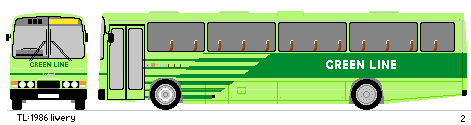 September 1986 saw the politically inspired break-up of London Country into four small companies
that were expected to fight tooth and nail for whatever business there was.
The GreenLine brand crumbled a bit with it, as the central control of image and policy vanished.
The remaining fragments of Green Line with the new companies were in some cases too small to be worth
the extra effort of inter-company co-operation, even if that were legal.
September 1986 saw the politically inspired break-up of London Country into four small companies
that were expected to fight tooth and nail for whatever business there was.
The GreenLine brand crumbled a bit with it, as the central control of image and policy vanished.
The remaining fragments of Green Line with the new companies were in some cases too small to be worth
the extra effort of inter-company co-operation, even if that were legal.
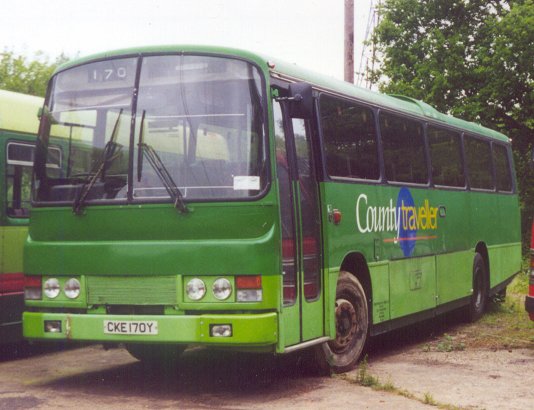
The TLs were divided, by their allocations, to all four companies: Slough was with LCNW; St.Albans with LCNE; Reigate and Dorking with LCSW and Northfleet and Dartford with LCSE. These last were soon renumbered into the Kentishbus coach numbering scheme. Kentishbus: TL5, 31-38, 41Six year leases expired in spring 1988, and Kentishbus promptly returned theirs, with Ensign Bus at Purfleet handling the off-lease arrangements. Some went to Chartercoach in Essex for National Travel work, four to Blackburn Transport, and the others to a variety of smaller operators.London Country North East: TL6, 17-18, 20, 24, 27LCNE withdrew their six into store at Hatfield in June 1988, then arranged to buy them. The batch was transferred to Grays to replace LRC Olympians on the 722 commuter journeys. Countybus acquired them in the LCNE split, and some were transferred into the Sampson's coach fleet at Hoddesdon, being painted cream and blue. TL31 and TL33 (ex Kentishbus) were bought from Chartercoach in September 1989 and added to the Sampson's fleet. TL6, 18 and 24 were transferred to Midland Red North in September 1991 after a fire at Stafford, and after a period in service received new East Lancs bus bodies. TL15 and TL30 were bought from Luton & District in March 1993, and TL13 was bought back from preservation.London Country South-West: TL1-4, 7, 14, 21-22, 25-26, 39LCSW kept theirs until April 1989, when they were promptly withdrawn and dispatched to Midland Red North. All eleven were rebodied with new East Lancs bus bodies to take them on to the Millenium.London Country North-West: TL8-13, 15-16, 19, 23, 28-30, 40, 42The Slough expresses stayed in service with London Country North-West, belting backwards and forwards between London and Heathrow, Windsor, Legoland and Bracknell. Quite what arrangement LCNW made with Leyland at the lease expiry I don't know, but most continued in service until the spring of 1991. Some then went to a dealer in Scotland (and thence to Scottish independents, and some to Countybus. Some came back to Luton & District with the Stevenage takeover, only to revert to Countybus again in 1993.
|
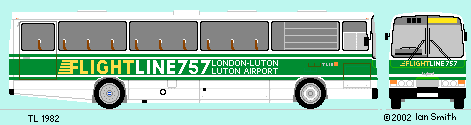 TL 1-6 received Flightline 757 livery for the London to Luton Airport service,
and after receipt at Reigate went to St.Albans for a July start on the service.
They stayed on the airport run until the spring of 1986, when it was taken over by Luton & District,
TL1-4 then being transferred to Dorking and used on the Brighton and Hove service (still in Flightline livery!).
TL5 moved to Dartford, with a new paint scheme, of pale green with dark green combing -
another attempt by National Bus Company to impose a common identity in the face of burgeoning livery variations among its subsidiaries.
TL6 remained at St.Albans, and received a repaint to Green Line livery in October 1987.
TL 1-6 received Flightline 757 livery for the London to Luton Airport service,
and after receipt at Reigate went to St.Albans for a July start on the service.
They stayed on the airport run until the spring of 1986, when it was taken over by Luton & District,
TL1-4 then being transferred to Dorking and used on the Brighton and Hove service (still in Flightline livery!).
TL5 moved to Dartford, with a new paint scheme, of pale green with dark green combing -
another attempt by National Bus Company to impose a common identity in the face of burgeoning livery variations among its subsidiaries.
TL6 remained at St.Albans, and received a repaint to Green Line livery in October 1987.
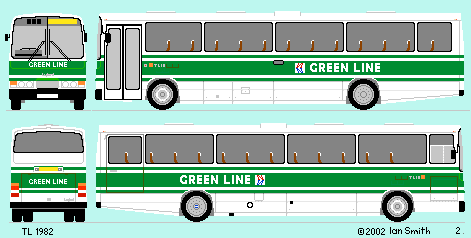 TL 7-30 arrived in Green Line livery, with a white base and three Lincoln green bands.
They were divided between Windsor, Reigate and St.Albans, all garages with motorway Green Line express routes.
The Windsor contingent were perforce transferred to Slough in July 1984,
when Windsor closed and Slough opened. There was a small amount of swapping between the garages,
and TL14 went to Dorking in 1986 (in place of TL6?).
TL 7-30 arrived in Green Line livery, with a white base and three Lincoln green bands.
They were divided between Windsor, Reigate and St.Albans, all garages with motorway Green Line express routes.
The Windsor contingent were perforce transferred to Slough in July 1984,
when Windsor closed and Slough opened. There was a small amount of swapping between the garages,
and TL14 went to Dorking in 1986 (in place of TL6?).
 Ian's Bus Stop
 Index
Index DL,PL
DL,PL TL text
 histories